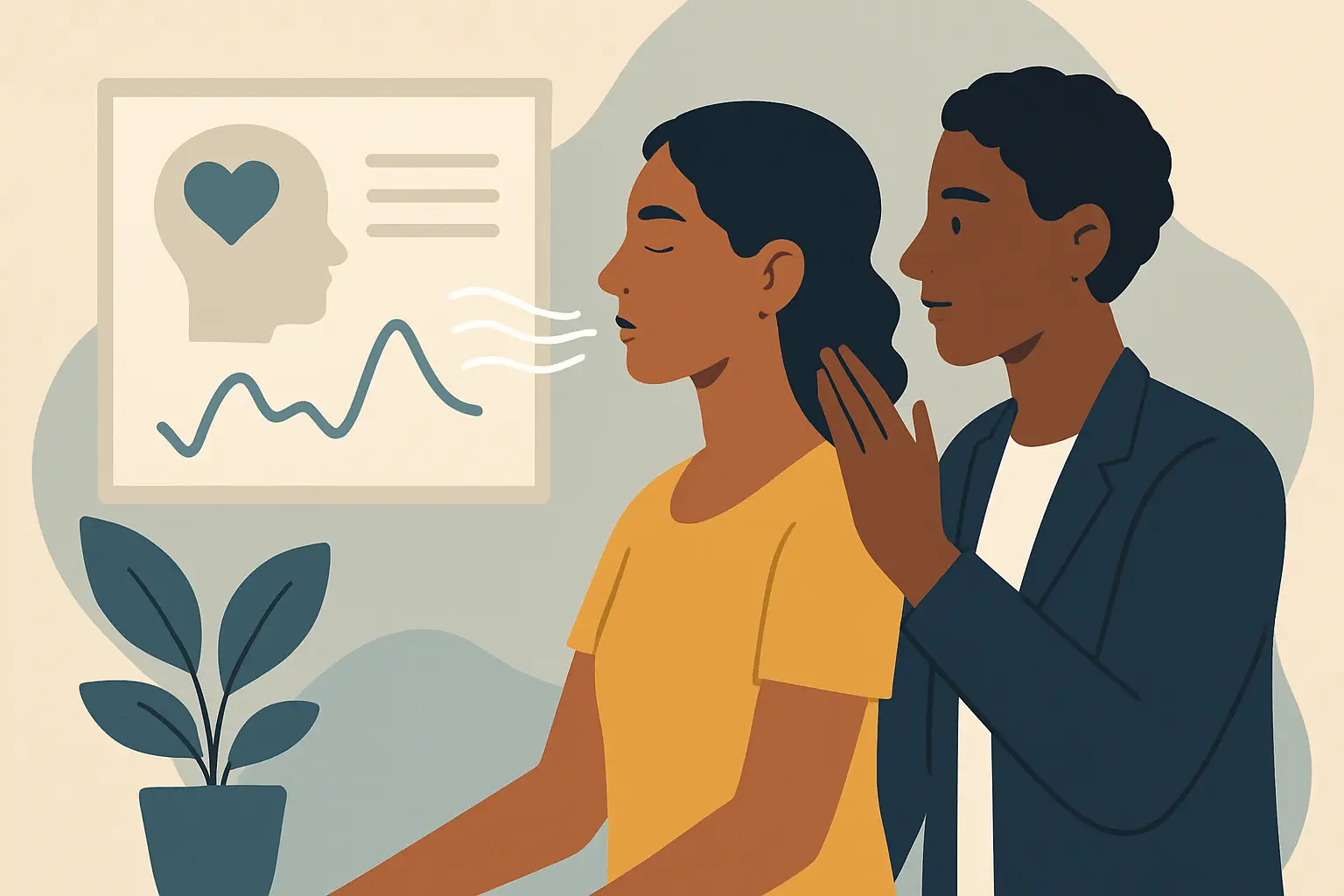
Someone starts breathing faster, their hands begin to tingle, their jaw tightens – and suddenly their whole system looks like it is trying to tell the truth all at once. If you are the person holding the room, you can feel the moment when breathwork shifts from “powerful” to “potentially too much”. That edge is exactly why trauma informed breathwork training matters. Not because breathwork is dangerous, but because it is effective – and effectiveness asks for competence.
For yoga teachers, therapists, coaches, bodyworkers and purpose-led facilitators in the UK, trauma-informed breathwork training is not a trendy add-on. It is the difference between a client leaving a session feeling resourced and integrated, or leaving flooded, confused, and alone with what opened up. And if you are building a professional pathway – running paid 1:1s, couples sessions, circles, retreats, festivals – it is also the difference between “I can guide breathing” and “I can hold people”.
What “trauma-informed” really means in breathwork
Trauma-informed does not mean you are treating trauma, diagnosing anyone, or trying to replace psychotherapy. It means you understand how trauma lives in the nervous system, and you facilitate in a way that prioritises safety, choice, dignity and pacing.
In breathwork, this becomes very practical very quickly. Breath can amplify sensation, emotion, memory, images and body-based impulse. That is often part of the healing. Yet the same amplification can also push someone into overwhelm if the container is not built well.
A trauma-informed facilitator keeps asking: what is the client’s system able to digest right now? Not what would make the session dramatic, cathartic, or impressive.
The heart of it is simple – you are helping someone come closer to themselves without forcing anything to happen.
Why breathwork can touch trauma so fast
Conscious connected breathing can move energy, emotion and sensation in minutes. Clients often report tears, shaking, warmth, tightness in the throat, old grief, sudden fear, or spontaneous joy. This does not necessarily mean “trauma is being released”, but it can be the nervous system processing stored survival responses.
Trauma is not only what happened. It is what the body had to hold when it was too much, too fast, or too alone. Breathwork changes carbon dioxide and oxygen balance, impacts the vagus nerve, and shifts attention into the body. For some people that feels like liberation. For others, being in the body is where the hardest things live.
That is why your skill is not measured by how intense a session becomes. It is measured by whether the client remains connected enough to choose, track, and return.
The real risks of “push through” facilitation
You will still see breathwork taught with a “breakthrough” mentality: push harder, breathe faster, get the release. For some resilient clients, that can feel empowering. For many others, it can recreate the very pattern that caused harm in the first place – having their internal boundaries ignored.
Overwhelm can look obvious: panic, hyperventilation, dissociation, freezing, or a client asking to stop but feeling embarrassed. It can also look subtle: a smile that does not reach the eyes, compliance, spiritual bypassing, or a client insisting they are “fine” while their body tells a different story.
Trauma informed breathwork training gives you alternatives. You learn how to work with intensity without demanding it. You learn how to downshift, titrate, and help people stay with what is true in small, honest doses.
Trauma informed breathwork training: what you should be learning
A solid training should leave you with more than a script and a playlist. It should change how you see the room. These are some of the core competencies that matter.
Nervous system literacy that translates into facilitation
You do not need to become a neuroscientist, but you do need working knowledge of fight, flight, freeze, fawn, and how regulation actually looks in real bodies. You should be able to recognise when a client is stretching in a healthy way versus when they are leaving the room internally.
Good training also teaches you what regulation tools belong to you as the facilitator: tone of voice, pacing, the way you give choice, how you use silence, when you make eye contact, and when you do not.
Consent, choice, and “opt out” as a feature, not a failure
Trauma-informed breathwork is consent-led. That means clients know, explicitly, that they can slow down, stop, change posture, open their eyes, sit up, or step out.
This is not about reducing transformation. It is about building it on truth. A client who feels free to stop is often the client who can go deeper – because their nervous system is not bracing against being trapped.
Screening and scope: knowing what you are holding
A training should teach you how to ask the right questions before you guide a deep journey. Breathwork can be contraindicated for certain medical conditions, and it can also be psychologically destabilising for some presentations. If you are working with people who have complex trauma, recent loss, severe anxiety, or a history of dissociation, your choices around session style and intensity matter.
Trauma-informed does not mean “never work with anyone who has trauma”. It means you screen, you set expectations, and you know when to refer, collaborate, or offer a gentler approach.
Pacing, titration, and resourcing skills
One of the most important skills in trauma-informed work is pacing. You learn how to let the body touch the edge, then return to safety. You learn resourcing: orienting to the room, feeling the support of the floor, connecting to a steady breath, naming a boundary, sensing a safe person in memory, or simply noticing “I am here, now”.
This is where breathwork becomes an art. Sometimes the bravest facilitation is slowing the group down, even when the music is building and the room could go bigger.
Integration that continues after the last breath
If your training ends the moment the breathwork ends, it is incomplete. Trauma-informed facilitation includes how you bring people back: gradual re-entry, hydration, grounding, gentle movement, and space for meaning-making without forcing a story.
Integration also includes the practicalities: how you follow up, how you talk about after-effects, and how you help clients recognise when they need extra support.
Group sessions versus 1:1: the trade-offs
It depends what you want to offer, and it depends what your clients need.
In 1:1 sessions, you can tailor pacing, language and intensity with precision. You can notice subtle cues, track the breath, and respond immediately. This can be ideal for clients with anxiety, trauma histories, or those new to somatic work.
In group sessions, the field can be profoundly supportive. People feel less alone, and the collective rhythm can help them surrender. But groups also carry more unpredictability. A trauma-informed group facilitator learns how to set strong agreements, offer modifications without singling anyone out, and keep the container steady even if someone has a big emotional release.
Couples breathwork adds another layer: attachment dynamics. A strong training should teach you how to keep the relational field safe, so one partner is not pushed into vulnerability while the other goes into fixing, analysing, or shutting down.
What to look for when choosing a training
You are not only choosing a method. You are choosing a lineage, a set of ethics, and a standard of care.
Look for a training that speaks clearly about trauma and nervous system safety, rather than using vague promises of “instant healing”. Ask how they teach facilitation, not just the breathing technique. Ask whether you will practise holding people through real responses, with feedback.
Also consider the professional pathway. If you want to run paid sessions, workshops and retreats, you need training that supports you with structure: how to open and close a session, how to brief clients, how to manage group energy, and how to stay within scope. Certification can matter for confidence, credibility, and in many cases insurance readiness.
Some trainings shine in deep spiritual experience but are light on facilitation mechanics. Others are very clinical but miss the heart. The sweet spot is a programme that honours both – soul and skill.
If you are called to a heart-led, Hawaiian-inspired approach that teaches conscious circular breathing alongside distinct methods such as Ha Breath, Wave Breath and Healing Heart Breath, you may resonate with Nalu Breathwork® as a certification pathway designed to support both emotional depth and professional readiness.
The facilitator’s inner work is part of the training
Trauma-informed is not only what you do with a client. It is also who you are in the room.
If you have not met your own urge to rescue, to push, to perform, or to avoid emotion, it will show up in your facilitation. The most skilled breathwork leaders are not the most dramatic. They are the most anchored. Their nervous system sets the tone.
A good training invites you into your own process with care. Not so you become “healed enough” – that is a myth. But so you can recognise your edges, your triggers, and your patterns, and choose professionalism over reaction.
This is also where community matters. When you are held by your own Ohana, it becomes easier to hold others without taking their experience home with you.
A note on spirituality and trauma: keep it human
Breathwork can be mystical. People may see colours, feel ancestors, experience unity, or have profound insights. There is room for that. But trauma-informed practice stays grounded.
If a client is overwhelmed, they do not need a cosmic explanation. They need stabilisation, permission to slow down, and the felt sense that they are not alone.
You can be spiritual and skilful at the same time. You can honour the sacred without bypassing the nervous system.
The bottom line: safety creates depth
The paradox is that safety is what allows intensity to be healing. When clients know they will not be pushed, they can soften into what is true. When they trust your pacing, they can surrender without losing themselves.
If you feel the call to become a facilitator, let your standard be this: be the person who makes it safe to feel. Not by controlling the experience, but by holding it with competence, humility and heart.
Closing thought: the breath will always be powerful – your gift is learning how to meet that power with tenderness, so the people in your care leave with more choice inside themselves than they arrived with.
Frequently Asked Questions
What does trauma-informed breathwork training involve in the UK?
Trauma-informed training teaches you to guide deep sessions with safety, consent, and pacing so clients release without overwhelm. Nalu Breathwork emphasises this for UK facilitators because breathwork is powerful, and competence is what separates simply guiding breathing from truly holding people through whatever surfaces.
Can breathwork training help me manage my own anxiety and stress in the UK?
Many UK students begin training partly for their own regulation, since conscious circular breathing techniques calm the nervous system and reduce stress. Nalu Breathwork’s trauma-informed approach teaches facilitators to work safely with anxiety, so the personal benefits often deepen alongside the professional skills gained.