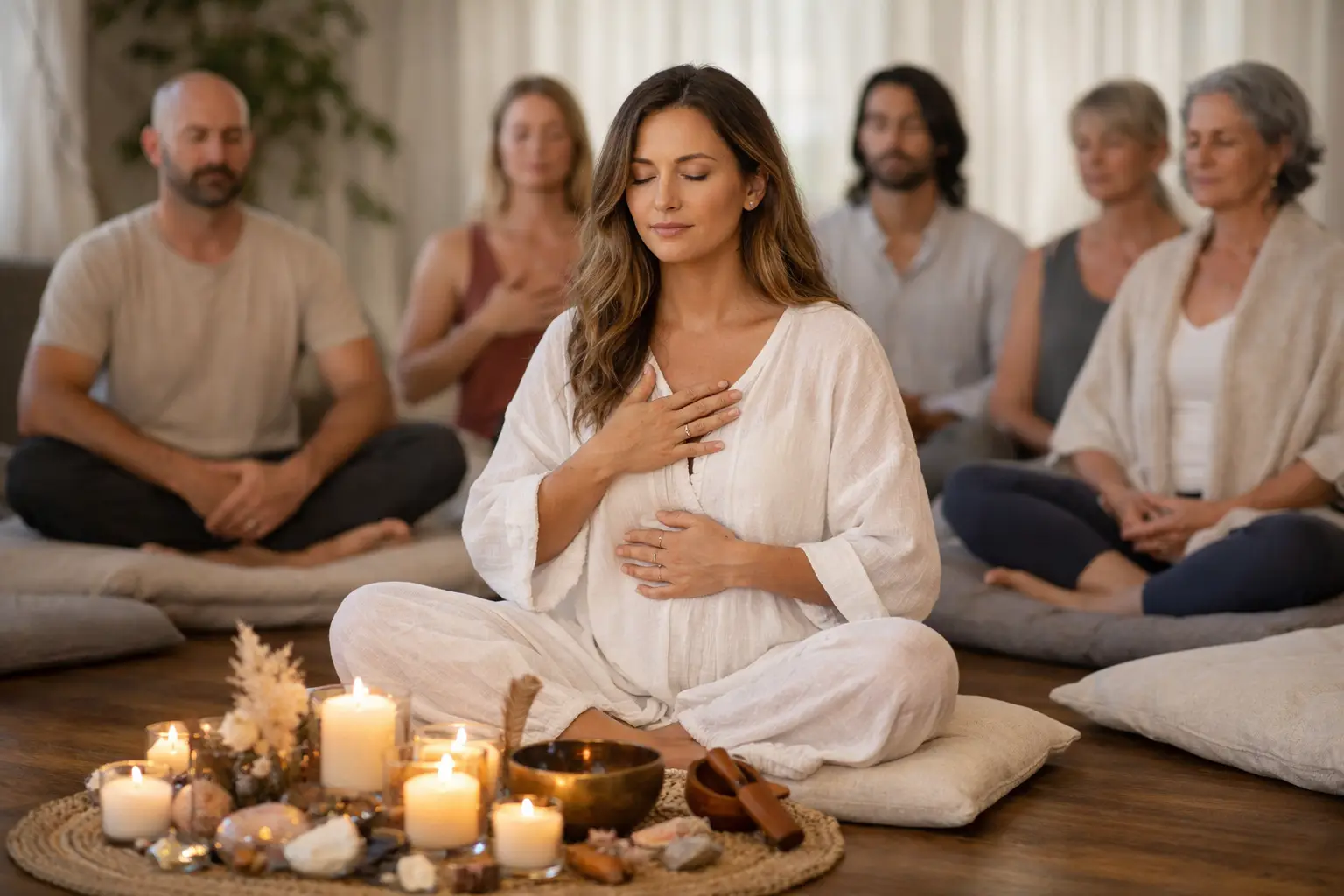
Someone arrives carrying fresh grief. Another has never breathed this way before and is nervous about letting go in front of a group. A third has come because she is the one everyone leans on, and she is tired of holding it all alone. This is why learning how to run sacred breathwork circles asks for more than good music and a beautiful room. It asks for presence, discernment, safety and a genuine capacity to hold transformation with heart.
For many conscious souls, the calling to lead circles begins with a powerful personal experience. You feel what the breath can open – release, clarity, peace, truth – and you want to offer that to your community. That desire is beautiful. But sacred space does not become safe or effective through intention alone. The strongest circles are carefully held, professionally guided and spiritually grounded.
What makes a breathwork circle sacred
A sacred breathwork circle is not simply a group session with candles. Sacredness comes from the quality of the container. It is created through clear intention, respectful boundaries, attuned facilitation and a shared agreement that what happens in the space matters.
That does not mean every circle must feel solemn or heavy. Some groups move through laughter, joy and tenderness as much as tears. Sacred means people are invited to meet themselves honestly. It means the facilitator is not performing healing, but stewarding a process that allows each person to connect with their own inner wisdom.
This is where many newer facilitators need to slow down. Deep experiences can happen quickly in group breathwork, especially when conscious circular breathing is used. Emotional release, body activation, memories and spiritual insight can all arise. A sacred circle honours that depth without dramatising it.
How to run sacred breathwork circles with safety first
If you want to know how to run sacred breathwork circles well, begin with safety. Not as an afterthought, but as the foundation. A beautiful theme or strong turnout means very little if the group is not properly screened and supported.
Before the session, participants need clear information about what the practice involves, what they may experience and whether the session is suitable for them. Contraindications matter. So does informed consent. If someone has a relevant physical or mental health concern, you need a process for assessing whether a group setting is appropriate or whether they would be better supported in a 1:1 environment first.
Safety also includes the emotional field. Group work can stir comparison, projection and vulnerability. Your role is to set a tone that is welcoming but well bounded. Let people know what confidentiality means, how they can regulate if the process feels intense, and what support is available during and after the breath journey.
A heart-led facilitator is not a permissive one. Real care includes structure.
Screening, scope and readiness
Not every person is ready for every circle. That is not exclusionary. It is responsible. Some people need slower pacing, more education or additional therapeutic support. Others may be physically present but unsure whether they truly want a cathartic process in a group.
A skilled facilitator knows the difference between encouraging healthy courage and pushing somebody beyond their window of tolerance. If your training has not prepared you to screen participants, manage activation and stay within your scope of practice, pause there. Sacred work requires competence.
Build the container before the breath begins
The most powerful part of a circle often happens before the active breathing starts. The way you welcome the room shapes everything that follows.
Choose a venue that feels private, calm and grounded. Participants should be physically comfortable, warm enough and able to lie down without feeling crowded. Music, lighting and altar pieces can support the experience, but they should never become a distraction from it. Simplicity usually serves more deeply than over-styling the room.
Then open the space with intention. This might include a short grounding practice, a few words about the purpose of the circle, community agreements and a reminder that each person is responsible for listening to their body. Keep your language clear. You are not trying to impress the room with spiritual vocabulary. You are helping people feel safe enough to surrender.
An effective opening also names the arc of the session. Tell participants what will happen, how long the breathing phase may last, when touch or hands-on support would or would not be used, and what integration will look like afterwards. Uncertainty can heighten anxiety. Clarity helps the nervous system settle.
Leading the breath with confidence and humility
When the breathing begins, the room changes quickly. Energy builds. Emotions surface. Some participants go inward; others become expressive. This is where facilitators can become either overly controlling or too passive.
The middle path is attunement. You are leading the process, but not forcing outcomes. You are tracking the group while staying connected to each individual enough to notice who may need encouragement, who needs grounding and who needs space.
Your guidance should be steady, simple and embodied. If your own system is scattered, the room will feel it. Speak less than you think you need to. Reassure without overtalking. Let the breath do its work.
Music matters here, but not in the way many assume. A playlist should support the emotional journey, not manipulate it. Pace matters. Silence matters too. If every moment is filled, participants may struggle to hear their own inner process.
Holding emotional release in sacred breathwork circles
Many people are drawn to this work because they have witnessed profound release. That release can be beautiful, but it should never become the measure of a successful session. Some participants tremble, cry or vocalise. Others become very still and leave transformed. Outer intensity does not always equal inner depth.
If someone is moving strong emotion, your job is to stay grounded and non-intrusive. Avoid making their process into a spectacle for the room. Offer support that is consent-based and relevant. Sometimes a simple reminder to keep breathing is enough. Sometimes the wisest intervention is helping them slow down.
This is one reason proper training matters so much. Reading energy is not the same as understanding trauma dynamics, nervous system responses and group safety.
Integration is where the circle becomes complete
A breathwork circle is not finished when the music ends. Integration is part of the facilitation, not an optional extra.
After active breathing, give people time. Time to rest, to notice, to return to the room gently. Rushing into sharing can pull participants out of a meaningful inner state too quickly. Let the body land first.
When you do invite reflection, keep it spacious. Not everyone will want to speak. Not everyone should be asked to explain what happened. A sacred circle respects silence as much as expression. Journalling, quiet contemplation or a gentle closing ritual can all support completion.
It is also wise to offer practical aftercare. Encourage hydration, rest and tenderness with whatever may continue unfolding over the next day or two. For some participants, insights arrive later. For others, emotions keep moving. Naming that can prevent people from feeling untethered after a powerful session.
The practical side of running circles professionally
If you hope to lead paid workshops, retreats or community events, sacred intention must sit alongside professional standards. This is especially true if breathwork is becoming part of your livelihood.
That means having clear intake processes, waivers, venue considerations, emergency planning and appropriate insurance. It means understanding the difference between a donation-based community gathering and a professionally facilitated event with real responsibility attached to it. It also means being honest about your level of experience.
Many wellness practitioners feel awkward discussing these practicalities because they worry it makes the work less spiritual. In truth, professionalism protects the sacred. When your systems are sound, you are freer to lead from the heart.
This is where structured facilitator education can change everything. A strong training does not just teach a breathing pattern. It prepares you to hold 1:1 sessions, couples work and group spaces with confidence, ethics and skill. It gives you a method, a framework and a standard you can return to when the room gets complex.
For those who feel called to lead circles as part of a genuine healing practice, that depth of preparation matters more than charisma. Nalu Breathwork, for example, places strong emphasis on both heart-led transformation and real-world facilitator readiness, which is exactly the balance this work asks for.
How to know you are ready to lead
You do not need to be perfect to hold sacred space. But you do need to be honest. Have you done enough of your own inner work to stay present when others unravel? Can you regulate yourself while guiding a room? Do you understand the method you are teaching, rather than improvising from instinct alone?
Readiness is not about having a polished persona. It is about steadiness, humility and training. The circle is not there to meet your need to be seen as wise or gifted. It is there to serve the people who have entrusted you with their breath, their bodies and often their deepest tenderness.
If you feel called to lead, honour that call fully. Learn well. Practise slowly. Build trust in your own facilitation through repetition, mentorship and grounded experience. Sacred circles can become profound spaces of remembrance, release and reconnection – but only when the person at the front knows how to hold both the mystery and the method.
Start there, and your circle will feel less like an event and more like a true homecoming for your soul tribe.