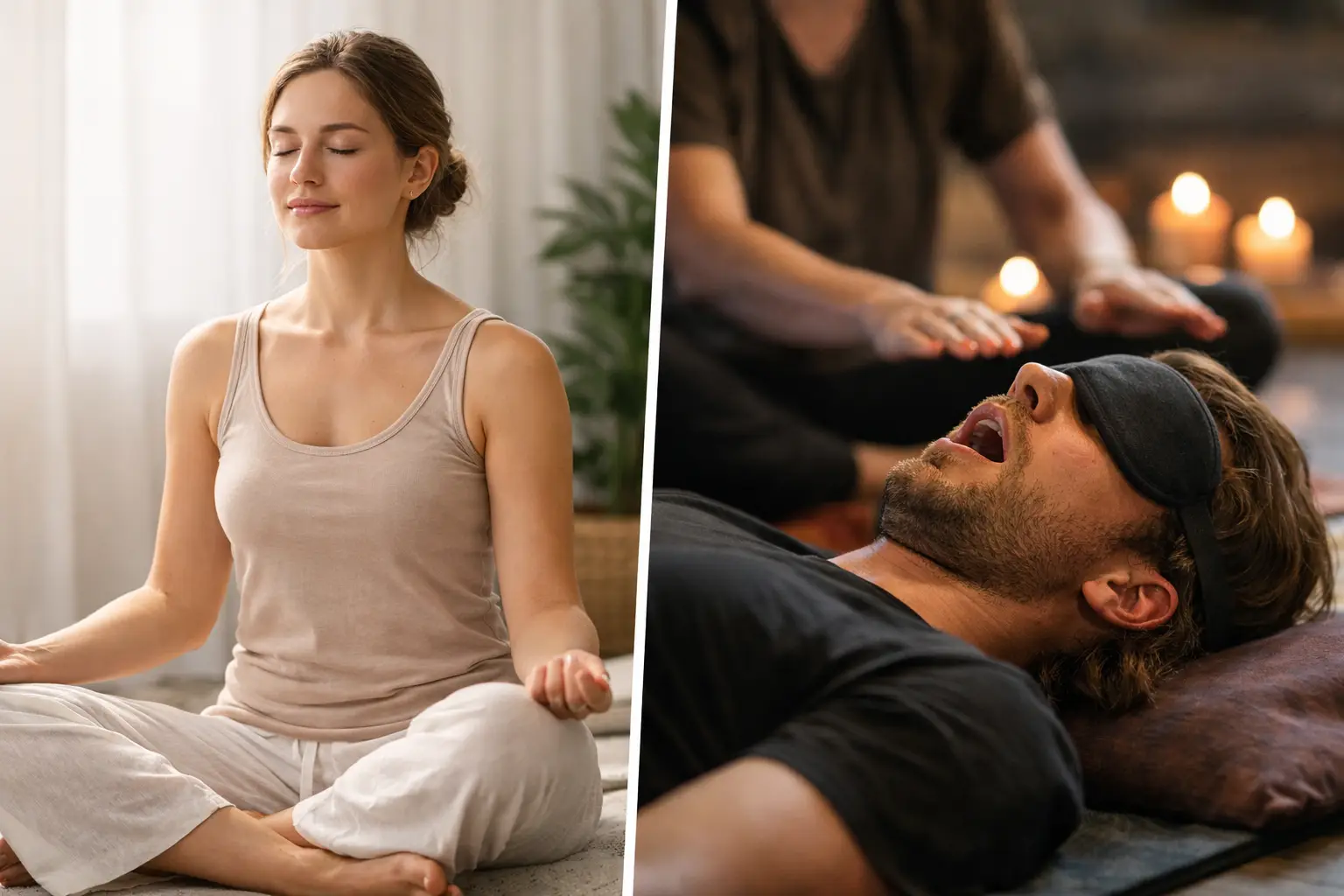
A breathwork session can look simple from the outside: a person lies down, breathes with intention and meets whatever rises. Yet the way the breath is guided changes the entire container. In conscious breathing versus holotropic breathwork, the meaningful question is not which approach is better. It is which practice, pace and level of support are right for the person in front of you.
For coaches, yoga teachers, bodyworkers and emerging facilitators, understanding that distinction matters. It helps you speak honestly about your work, choose appropriate session formats and hold your clients with both an open heart and clear professional boundaries.
Conscious breathing versus holotropic breathwork: the core difference
Conscious breathing is a broad term for bringing awareness and intention to the breath. It may be slow and regulating, gentle and meditative, or more active and emotionally evocative. Conscious circular breathing, for example, often uses a connected inhale and exhale without a deliberate pause. The breath becomes a pathway to sensation, emotion, memory, insight and a deeper relationship with self.
Because it is an umbrella term, conscious breathing can be adapted to the individual and the moment. A facilitator may invite a softer rhythm for someone arriving overwhelmed, or support a more energised connected breath when the person feels resourced, willing and appropriately screened. The art lies in listening rather than forcing an outcome.
Holotropic Breathwork is a named, more defined method created by Stanislav and Christina Grof. Traditionally, it combines accelerated breathing with evocative music, focused bodywork when appropriate, creative integration and a particular group structure. Sessions are commonly longer and designed to support an immersive, non-ordinary state of consciousness.
Both approaches can be powerful. Both may bring emotional release, physical sensations, imagery or spiritual experience. But they are not interchangeable labels. Holotropic Breathwork carries a specific lineage, format and intensity. Conscious breathing describes a wider family of breath-led practices, including methods that can be offered in gentler, shorter or more tailored ways.
The breath is only one part of the experience
People often compare modalities by breath pattern alone. In practice, the container has just as much impact as the technique. Music, touch policy, session length, group size, preparation, facilitator presence and integration all influence what a participant experiences.
A traditional Holotropic Breathwork setting may involve several hours, with participants working in pairs as breather and sitter. The extended musical arc and dedicated integration time are part of the method, not optional extras. This can create a powerful communal field, particularly for people seeking a deep and uninterrupted inner journey.
Conscious circular breathing can also be held in a longer ceremonial space, but it can be structured differently. A one-to-one session may allow for more individual attunement. A couples session may centre connection, communication and co-regulation. A group workshop may offer a carefully paced shared experience with clear opening and closing practices. None of these formats is automatically more healing than another. Fit matters.
At Nalu Breathwork®, conscious circular breathing is taught alongside Hawaiian-inspired practices such as Ha Breath, Wave Breath and Healing Heart Breath. These offer facilitators a wider language for working with breath, heart connection and embodied presence, rather than relying on one intensity level for every client and every intention.
Intensity is not a measure of transformation
There can be a quiet belief in wellness spaces that the most cathartic session is the most effective one. A dramatic release may feel meaningful, and sometimes it is. Yet tears, shaking, tingling, laughter or vivid memories are not badges of success. Nor is a calm, subtle session somehow less valuable.
Some people benefit from a strong, extended experience when it is well screened, skilfully held and followed by genuine integration. Others may need a slower entry point, especially if they are living with high stress, grief, exhaustion or a history that makes intensity feel destabilising. A person may also want different things at different times in their life.
For a facilitator, this is where discernment becomes a sacred responsibility. Your role is not to manufacture a breakthrough. It is to create conditions where a participant has choice, agency and enough support to stay connected to themselves.
That may mean offering permission to slow the breath, return to natural breathing, open the eyes, sit up, drink water or simply rest. It may mean acknowledging that breathwork is not the right support today. Holding space includes knowing when not to push.
Safety and scope come before the session
Active breathwork can affect the body and nervous system. Faster or more forceful breathing may lead to light-headedness, tingling, cramping in the hands, strong emotion or altered perception. These responses deserve preparation, not surprise.
A responsible facilitator screens participants, explains the practice in plain language, gains informed consent and gives clear choices throughout. They understand the contraindications and referral boundaries relevant to the method they offer. Depending on the person’s medical history, current medication, pregnancy, cardiovascular health, seizure history, recent surgery or mental health presentation, participation may need medical clearance, modification or a different form of support.
This is not about making breathwork fearful or clinical. It is about honouring the truth that powerful practices need skilled care. Breathwork facilitation is not psychotherapy, diagnosis or emergency treatment. When someone needs medical, psychiatric or therapeutic support, an ethical facilitator encourages them towards the right qualified professional and collaborates within appropriate boundaries.
For those building a professional practice, safety also includes the practical foundations: a thorough intake process, appropriate insurance, clear waivers, confidentiality, incident procedures and ongoing supervision or mentoring. Heart-led work becomes more trustworthy when it is paired with competent structure.
How to choose the right practice for your client or community
Start with the purpose, not the trend. Is someone looking for a daily practice to settle their nervous system? Are they seeking a spacious personal session to explore emotion? Do they want a carefully held group journey? Or are they specifically drawn to the established Holotropic Breathwork format and its depth of immersion?
Then consider capacity. A participant’s willingness is not the same as readiness. Ask about their previous experience with breathwork, their support system, current stress load and what helps them feel grounded. Listen to what is said, but also notice whether their expectations are centred on curiosity and self-care or on chasing a dramatic release.
Finally, be honest about your own training. If you are trained in conscious circular breathing, do not present your work as Holotropic Breathwork. If you are facilitating a gentle breath awareness practice, do not promise a transformational catharsis. Clear language protects participants and strengthens your integrity.
This clarity can also help you design offers with confidence. A 60-minute one-to-one session, a couples practice, a two-hour workshop and an all-day retreat each require different preparation, pacing and integration. The more deeply you understand the method you are teaching, the more confidently you can lead sessions, workshops, retreats, festivals and sacred circles without overreaching.
Integration is where the practice meets real life
Whether a session is quiet or expansive, what happens afterwards matters. The breath may reveal a feeling, belief or body sensation, but insight needs time to settle into daily life. Integration can be as simple as rest, nourishment, journalling, gentle movement, time in nature or a conversation with an appropriate support person.
A skilled facilitator does not rush participants from an intense inner experience back into the car park. They leave room to orient, hydrate and name what feels present. In group work, they create a culture where sharing is invited but never required, and where people are not encouraged to interpret each other’s experiences.
This is one of the greatest gifts you can offer your soul tribe: not a promise that every session will change everything, but a grounded space in which change can unfold at an honest pace.
The question to carry forward is simple: what kind of breathwork container allows this person to feel both brave enough to explore and supported enough to return fully to themselves? Let that answer guide the breath, the method and the way you lead.