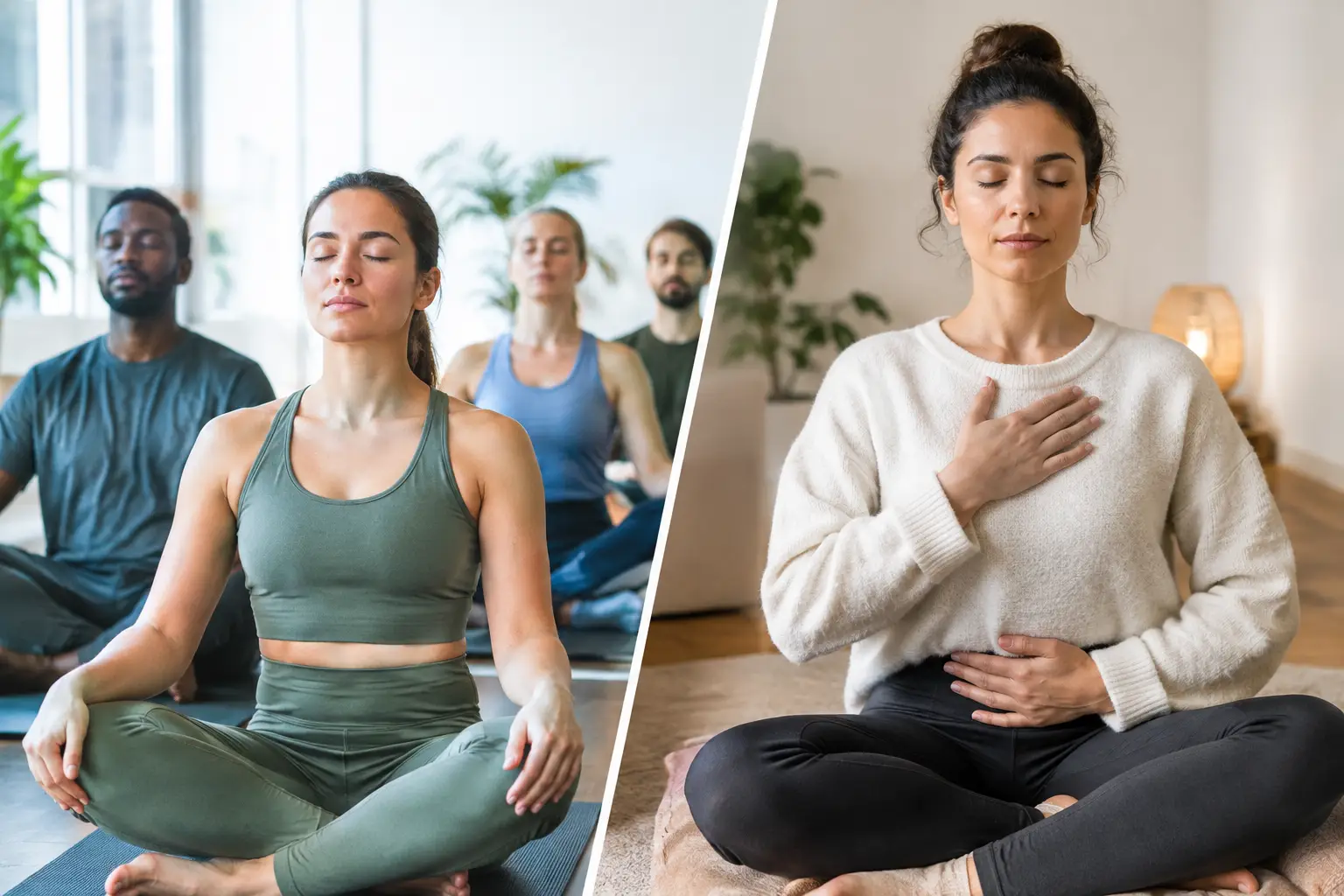
A room breathing together can feel like a tide coming in. One person sighs, another sheds tears, and the whole space seems to soften without anyone needing to explain why. Yet for some people, that same room can feel too exposed, too stimulating, or simply not where their healing wants to begin. The choice between group versus private breathwork is not about which experience is more powerful. It is about the kind of support, pace and connection that serves the person in front of you.
For wellness professionals and emerging facilitators, understanding this distinction is essential. You may feel called to lead sacred circles, intimate one-to-one sessions, couples work, retreats, or all of the above. Each format asks for a different quality of presence and a different approach to holding space.
What group breathwork can awaken
A group breathwork session carries the medicine of shared intention. Participants arrive as individuals, yet often leave with the felt sense that they are not alone in their grief, stress, longing or desire for change. When conscious circular breathing is held safely in community, the collective energy can support people to go further than they expected.
There is something deeply reassuring about witnessing another human being allow emotion to move. It can loosen the old belief that tears are weakness, anger is unacceptable, or joy must be contained. In a well-held group, people are not asked to perform their healing. They are invited to meet themselves while being quietly witnessed by an Ohana of fellow travellers.
Groups can be especially supportive for people seeking connection after isolation, those drawn to spiritual community, and clients who benefit from the momentum of a shared experience. They also create an accessible entry point for someone who is breathwork-curious but not yet ready to commit to private sessions.
For a facilitator, group work can be expansive and practical. You can serve more people at once through workshops, retreat sessions, festivals and regular community circles. It gives you an opportunity to develop your voice, pacing, music curation and capacity to hold a room with grounded confidence.
But a group is not simply a private session with more mats on the floor. The facilitator must be able to read the whole room while staying attentive to individual needs. Clear preparation, consent, contraindication screening, boundaries and post-session integration matter enormously. A beautiful atmosphere is not a substitute for skilled space-holding.
The limitations of the group setting
Group work has natural limits. A facilitator cannot offer every participant continual individual attention, and some people may hold back because they fear being seen in an emotional moment. Others may become distracted by the sounds or movements around them.
The pace also belongs to the group rather than one person. Even when there is room for individual variation, the arc of the session needs to serve everyone. This can be liberating for some and frustrating for others, particularly clients with a complex personal history or a strong need for tailored support.
The intimacy of private breathwork
Private breathwork creates room for a more personalised journey. The client does not need to match anyone else’s rhythm, process or level of openness. Their intention can be explored in greater depth, whether they are navigating grief, chronic stress, a relationship transition, a recurring emotional pattern, or a desire to reconnect with their own inner wisdom.
In a one-to-one setting, the facilitator can slow down, notice subtle shifts in breath and body language, and adapt the experience with greater precision. There is more time for conversation before and after the breathing practice, which can help a client make sense of what is arising and choose a gentle next step.
This format can feel safer for someone who is new to emotional release, highly private, or unsure how they will respond. It can also be valuable for clients who want continuity over several sessions. Rather than treating breathwork as a single powerful event, they can build a relationship with the practice over time.
For facilitators, private sessions develop a different kind of mastery. You learn to listen beneath the words, work without relying on group momentum, and trust the spaciousness of silence. You may draw on practices such as Ha Breath, Wave Breath or Healing Heart Breath according to the client’s intention and capacity, rather than delivering one fixed experience.
Private does not always mean better
Individual attention is valuable, but it is not automatically the right answer. Some clients can become overly focused on their own process when they would benefit from the perspective and belonging of a community. Others may find a private session too intense because all attention is on them.
Private sessions also tend to require a greater financial and time commitment. This can make them less accessible for people who would genuinely benefit from breathwork but need a lower-cost first experience. A group workshop may be the very doorway that helps them decide whether deeper one-to-one work feels right.
Group versus private breathwork for different intentions
The most useful question is not, “Which format gets the biggest release?” Release is only one possible outcome, and it should never be forced. Ask instead: what support does this person need to feel resourced, respected and able to stay connected to themselves?
A group setting may be a strong fit for a client who wants community, inspiration and a shared ritual. It can suit someone celebrating a life transition, joining a retreat, or seeking a regular practice that brings them back to themselves each month. It may also be ideal for workplaces or wellness communities when the session is designed with appropriate care and clear expectations.
Private breathwork may be a better fit when someone wants focused attention, has specific intentions they do not wish to share in a group, or needs a slower, more tailored approach. Couples sessions offer another meaningful middle ground. They can help partners practise presence, communication and co-regulation while each person still has space for their own experience.
A skilled facilitator does not push every client into the format that is most convenient to sell. They recommend what is most aligned. Sometimes that means beginning with a group taster and moving into private work. Sometimes it means a series of one-to-one sessions followed by a circle where the client can experience safe connection. Healing rarely follows a straight line.
What this means for your breathwork practice
If you feel called to make breathwork part of your professional path, training across formats matters. Leading a room of 30 people asks for clear structure, energetic awareness and practical systems. Supporting one person asks for sensitivity, attunement and the confidence to adapt without losing the safety of the container.
It also matters because your future clients will not all want the same thing. A yoga teacher may begin by offering small circles after class. A therapist-in-training may feel drawn to complementary, carefully bounded one-to-one sessions. A retreat leader may want to guide groups in transformative settings, while a bodyworker may offer breathwork as a stand-alone session for returning clients.
Nalu Breathwork® training is designed to help facilitators understand how to hold one-to-one, couples and group sessions with a heart-led approach and professional responsibility. Certification is not only about learning a breathing technique. It is about becoming trustworthy in the moments when someone feels vulnerable, emotional, joyful, quiet or unsure.
Safety is the thread through every format
Whether you are facilitating one client or a full circle, emotional depth should never be confused with intensity for its own sake. Breathwork can bring powerful sensations, memories and feelings to the surface. Your role is to offer choice, invite self-awareness and help participants remain within a manageable range of experience.
That means setting expectations before a session, screening thoughtfully, making modifications available, and reminding participants that they remain in charge of their bodies. It means knowing when a participant may need additional support beyond the scope of a breathwork session. Breathwork facilitation is a healing art, but it is not a replacement for medical, psychological or crisis care.
The strongest facilitators are not those who promise dramatic breakthroughs. They are the ones who create enough steadiness for meaningful transformation to emerge in its own time.
When choosing between a circle and a private session, let the answer be guided by the person, not the trend. The right setting is the one that lets breath become a bridge back to safety, truth and the quiet wisdom already waiting within.