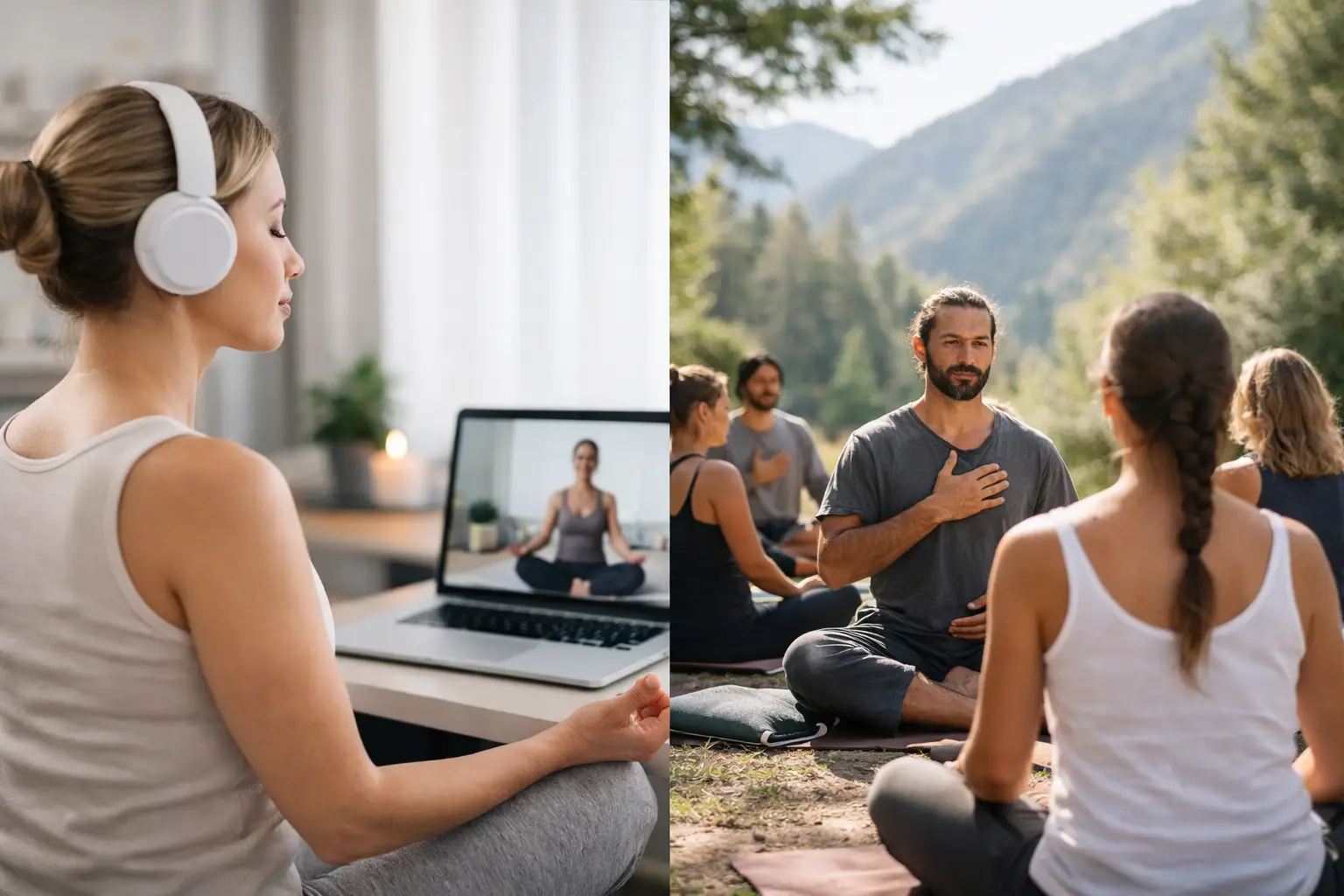
If you’re weighing online breathwork certification vs in person retreat, you’re likely not just choosing a course. You’re choosing how you want to be shaped as a facilitator, how you learn best, and what kind of space-holder you want to become for the people you serve.
For many in our soul tribe – yoga teachers, therapists, coaches, bodyworkers, retreat leaders – this decision sits at the meeting point of calling and practicality. You want a training that feels aligned, heart-led and deeply healing. You also want something credible, structured and strong enough to support real client work, insurance pathways and paid sessions. Both formats can offer genuine transformation. The better question is not which one is universally best, but which one is best for you, right now.
Online breathwork certification vs in person retreat: what really changes?
The biggest difference is not simply the screen or the setting. It is the learning environment.
An online certification usually gives you flexibility, repeatable lessons and time to integrate at your own pace. This can be a gift if you are already holding a busy practice, parenting, travelling for work or balancing multiple responsibilities. You can return to the material, rewatch demonstrations and absorb facilitation frameworks in stages rather than all at once.
An in person retreat creates immersion. You step out of ordinary life and into an intentional field where breath, practice, reflection and community are held together in real time. That compressed environment often accelerates personal breakthrough. It can also reveal how you respond under pressure, in group dynamics and in the energetic reality of holding others.
Neither format is automatically deeper. Depth comes from the quality of the training, the safety of the method, the skill of the teachers and your willingness to do the inner work. Still, the route into that depth can feel very different.
Who tends to thrive in online learning
Online learning suits people who are self-directed and able to create sacred structure at home. If you are someone who journals after modules, practises consistently and takes responsibility for your own integration, an online certification can be incredibly potent.
It also supports learners who want time. Breathwork facilitation is not only about technique. It asks for nervous system awareness, emotional maturity, language, presence and discernment. Some students benefit from being able to sit with one concept for a week before moving on. They want room to practise conscious circular breathing, understand contraindications, refine cueing and gradually grow their confidence.
There is another practical advantage. Online training can be more financially accessible once you factor in flights, accommodation and time away from work. For someone building a healing business carefully, that matters. If the training is well designed, with clear methodology and strong support, online study can absolutely lead to professional readiness.
That said, online learning asks more from your discipline. It is easier to postpone a module than it is to leave a retreat room. It is easier to stay in the comfort of theory than to fully embody your facilitator voice. If you know you tend to overthink, delay or stay in your head, this format may need extra accountability.
Who tends to thrive in a retreat setting
An in person retreat is often ideal for those who learn through embodied experience and direct feedback. You are not only hearing how to hold a session. You are feeling the room, witnessing real-time emotional release, reading body language and learning how pacing, presence and safety live in the body.
For many aspiring facilitators, this is where confidence lands. You can practise guiding breath, receive immediate coaching and experience the subtle art of space-holding beyond words. This matters when your future work may include one-to-one sessions, couples work, groups, workshops or retreats. Presence is taught partly through transmission, and retreat settings can carry that beautifully.
There is also the community element. Healing in an Ohana of like-hearted people can soften self-doubt and strengthen trust in your path. You may arrive curious and leave feeling claimed by your work. That is not a small thing.
The trade-off is that retreats require more logistics, more expense and more concentrated emotional energy. Not everyone is able to step away from life for several days. Not everyone integrates best in a compressed window. A powerful retreat can change you quickly, but quick transformation still needs ongoing grounding afterwards.
Safety, supervision and facilitator competence
This is where the conversation becomes more meaningful than preference alone.
A breathwork training should prepare you to work safely with stress, grief, trauma responses and strong emotional release. It should teach more than a breathing pattern. You need to understand screening, session structure, regulation, consent, contraindications, integration and how to stay within scope.
In person training has an obvious strength here. Teachers can observe your posture, pacing, language and capacity to track participants moment by moment. They can correct you on the spot. They can watch how you respond when something unexpected happens in the room.
Online training can still do this well, but only if it includes real assessment, guided practice and meaningful feedback rather than passive content consumption. A polished video library is not enough on its own. If your goal is to become a competent facilitator, not just a passionate student, then supervision and demonstrated skill matter enormously.
This is why some of the strongest pathways blend structure with embodiment. A good programme should help you understand the method intellectually, experience it personally and practise it relationally. Whether that happens online, in person or through both, the standard should be clear – can you safely hold people through breath-led transformation?
Career outcomes and credibility
If you want to earn from breathwork, the format matters less than the outcome.
Can the training certify you in a way that supports insurance applications where relevant? Does it teach you how to lead one-to-one sessions, couples sessions and groups? Are you being prepared for real-world spaces such as workshops, retreats, festivals and sacred circles? Are you learning a clear, repeatable method rather than collecting inspiration?
This is where many people get distracted by atmosphere. A beautiful retreat in a stunning location may be life-changing, but personal healing is not the same as facilitator training. Likewise, an affordable online course may sound efficient, but if it leaves you unsure how to open, guide and close a paid session safely, it has not truly served your professional path.
A heart-centred training should still produce grounded practitioners. That means method, ethics, confidence and practical application. It means your future clients feel held, not just moved.
Cost, access and the reality of your season
Sometimes the wisest choice is simply the one you can fully commit to.
If an in person retreat would place you under financial strain, create family stress or leave you rushing back into ordinary life without integration, it may not be the right step yet. If online learning would keep you stuck in isolation and indecision, it may be cheaper but ultimately cost you confidence.
There is no virtue in forcing a format that does not match your season. Some people begin online, build knowledge and rhythm, then deepen through retreat immersion later. Others need the retreat first because embodiment and community are what open the door. It depends on your nervous system, learning style, responsibilities and readiness to be seen.
How to decide without second-guessing yourself
Ask yourself a few honest questions. Do you learn best through reflection and repetition, or through immersion and live feedback? Do you need flexibility, or do you need a container strong enough to keep you fully present? Are you mainly seeking personal healing, professional certification, or both at once?
Then look carefully at the training itself. Not the branding alone, not the destination, not the promise of transformation. Look at the method, the lineage, the structure, the teacher experience and the clarity around what you will actually be able to do when you finish.
A programme such as Nalu Breathwork can appeal to both kinds of learners because the heart of the work is not only spiritual but practical. You are learning to facilitate conscious circular breathing with safety, depth and purpose, while also developing the confidence to lead sessions that genuinely support others.
The right path is the one that helps you embody the work, not merely admire it from afar. If that happens online, honour that. If it happens in retreat, honour that too.
Your future clients will not ask whether your most meaningful lesson happened on a laptop or in a retreat room. They will feel whether you are present, trained, safe and true in the way you hold them. Choose the path that helps you become that person, and let that be enough.