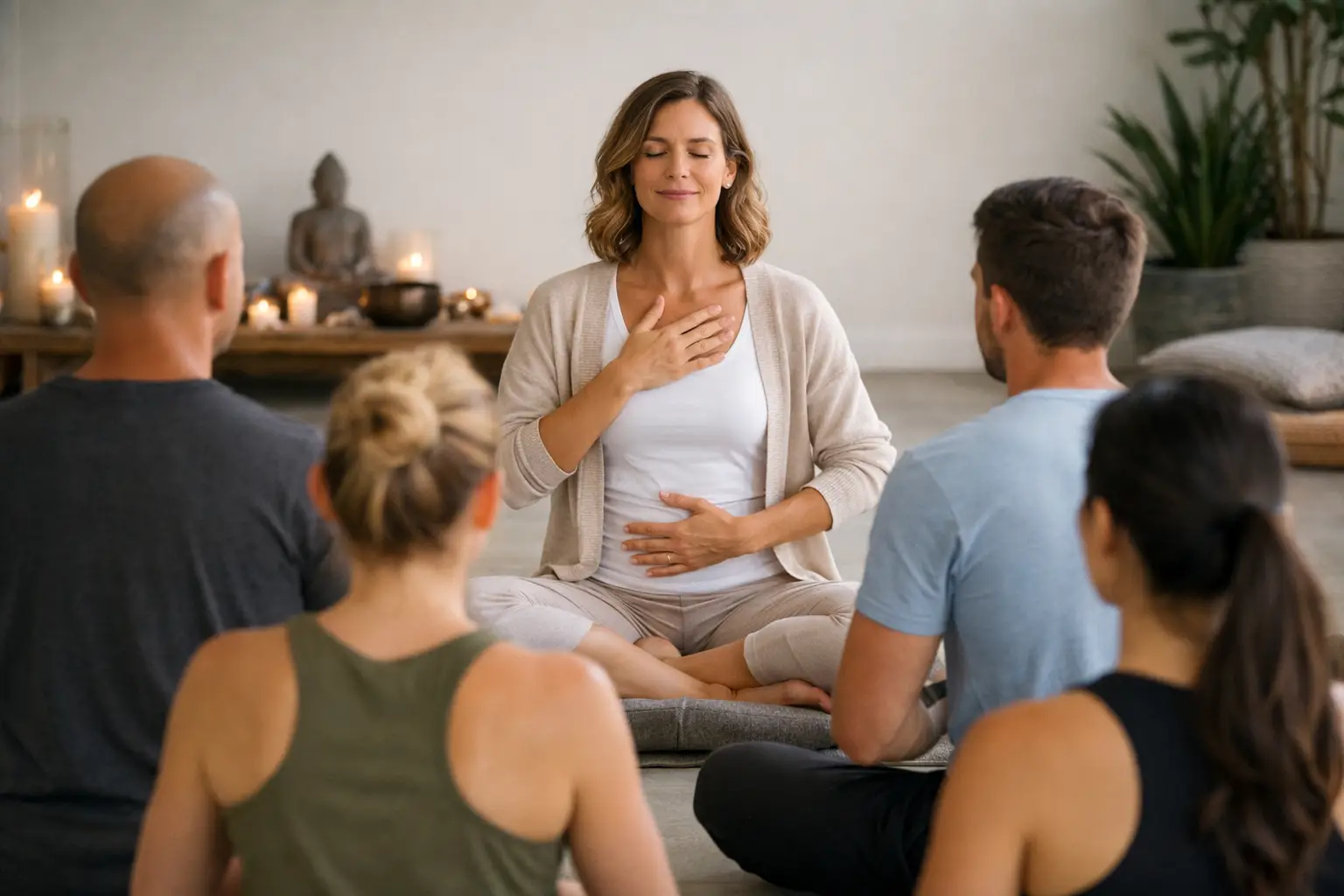
A group breathwork session can become a profound shared experience: a room of people softening out of the mind, returning to the body, and remembering they do not have to carry everything alone. But the quality of that experience rests on more than a beautiful playlist or powerful words. If you are learning how to lead group breathwork, your first responsibility is to create a space where people feel safe enough to be real.
That means leading with presence, clear boundaries and a method you understand deeply. Breath can stir emotion, memory and physical sensation. Your role is not to force a breakthrough. It is to hold a steady, heart-centred container where each person remains in choice throughout their journey.
Begin with the facilitator, not the playlist
Before participants enter the room, arrive in your own body. Take a few quiet breaths, feel your feet on the floor and notice whether you are trying to prove yourself, rescue someone or manufacture a big experience. Group facilitation asks for grounded leadership, not performance.
A group will often respond to the nervous system of its facilitator. When you are regulated, observant and unhurried, participants are more likely to settle. When you rush, over-explain or become anxious about silence, the room can feel less secure.
Prepare the practical details with the same care. Check the temperature, lighting, music system and layout. Make sure people have enough personal space, with clear access to a door, water and a bathroom. Mats, blankets and cushions can support comfort, but they also communicate something essential: you have thought about their wellbeing before they arrived.
Set a clear, consent-led container
The opening of a group session is where trust begins. Welcome people warmly, introduce yourself and explain what the practice may involve in simple language. Avoid promising healing, catharsis or transformation. Every person’s response to breathwork is different, and a quieter experience can be every bit as meaningful as an emotional one.
Explain the breathing technique you will use and demonstrate it before asking anyone to begin. In conscious circular breathing, the inhale and exhale flow continuously without pauses. Invite participants to work at an intensity that feels manageable for them, rather than treating effort as a measure of success.
Give permission to slow down, return to natural breathing, open the eyes, sit up, take a break or leave the room at any time. Choice is not a disclaimer to rush through. It is the foundation of safe space-holding, particularly for people with trauma histories or anxiety.
You should also explain touch boundaries. If you offer supportive touch, obtain clear consent before the session and make it easy for someone to change their mind. Never assume that a hand on a shoulder or heart will feel nurturing to every participant. Verbal guidance, distance and simple presence are often the most appropriate support.
Screen thoughtfully and know your scope
A confident facilitator does not try to hold every situation alone. Use a health questionnaire and invite participants to disclose relevant physical or mental health considerations before joining. Some people may need medical clearance, a gentler practice, or a different form of support altogether.
Breathwork is not a substitute for medical, psychiatric or therapeutic care. Be particularly careful where there is a history of serious cardiovascular conditions, uncontrolled high blood pressure, seizure disorders, pregnancy-related concerns, recent surgery, severe respiratory illness, psychosis, bipolar disorder or acute mental health distress. The appropriate approach depends on the individual, the method and their professional support network.
Have an emergency plan. Know the venue address, keep a phone accessible and understand when to seek urgent help. Just as importantly, know the limits of your training. You can compassionately support emotional expression without diagnosing, interpreting trauma or presenting yourself as a therapist if you are not one.
How to lead group breathwork without over-leading
Once the session begins, your voice should offer an anchor, not become another demand. Start slowly. Invite participants to notice their body, their contact with the ground and the rhythm of their breath before building into a more active practice.
Use language that returns people to their own inner authority. Phrases such as, “Notice what feels true for you”, “You may choose to soften the breath”, and “There is nothing you need to fix right now” can be more supportive than telling people what they should be feeling.
A useful group rhythm has three broad movements: arrival, activation and integration. Arrival helps the nervous system settle and establishes the breath. Activation is the more focused breathing journey, where music and verbal cues may support emotional release, energy or insight. Integration gives people time to return gradually, rest and make meaning from their experience.
Do not fill every moment with words. Silence can allow a participant to hear themselves. Equally, do not disappear completely when intensity rises. Offer occasional reminders about choice, relaxation and natural breathing. Watch the room, not only your plan.
If someone becomes overwhelmed, approach calmly if appropriate and ask what they need. Encourage them to slow the breath, orient to the room, open their eyes or sit upright. Keep your tone low and steady. A dramatic response from the facilitator can increase alarm; grounded care helps restore safety.
Work with the energy of the whole room
Group breathwork is not simply a collection of individual sessions. People can be affected by the sounds, movements and emotional expression around them. Name this gently at the start: everyone is welcome to have their own experience, and everyone is asked to respect the experience of others.
Encourage participants to keep their focus on their own mat. Some may cry, laugh, shake, sigh or feel very little. None of these responses needs to be judged. Avoid creating an atmosphere where visible release is seen as more spiritual or more successful than stillness.
Music can help shape the arc, but it should never overpower your ability to read the room. Choose tracks with care, allowing for pauses and softer sections. A session does not need to keep escalating. Sometimes the most skilful choice is to lower the volume, simplify the guidance and let the group settle.
Hawaiian-inspired breath practices such as Ha Breath, Wave Breath and Healing Heart Breath can bring a beautiful heart-led quality to group work when taught with respect, clarity and proper training. The method matters less than your ability to deliver it consistently, understand its effects and adapt it responsibly to the people before you.
Close slowly enough for integration
The end of a breathwork session deserves as much attention as the peak. Bring participants back gradually to natural breathing, body sensation and the room around them. Allow enough stillness for their system to settle before inviting movement.
When people sit up, offer water and time. You may invite optional sharing, but do not pressure anyone to speak. A simple prompt such as, “What do you want to carry with you from this experience?” can help participants integrate without asking them to disclose more than they wish.
Remind the group that integration continues after they leave. Gentle food, hydration, rest, journalling, time in nature and supportive conversation can all be helpful. If difficult feelings remain intense, encourage participants to contact an appropriate healthcare or mental health professional.
Build competence before building bigger rooms
Leading a group of ten, thirty or one hundred requires more than confidence on a microphone. It requires practice in observation, pacing, consent, nervous-system awareness and ethical decision-making. Start with smaller groups, seek feedback and continue receiving supervision or mentoring as your practice grows.
For wellness professionals who want to bring breathwork into workshops, retreats, sacred circles or a paid facilitation practice, structured training provides the foundation that inspiration alone cannot. Nalu Breathwork teaches facilitators to combine heart-based practice with practical space-holding skills, so the work can be offered with both depth and professionalism.
A well-led session is not remembered because every person had the same dramatic release. It is remembered because people felt seen, respected and safe to meet themselves honestly. That is the quiet power you are learning to hold for your Ohana.