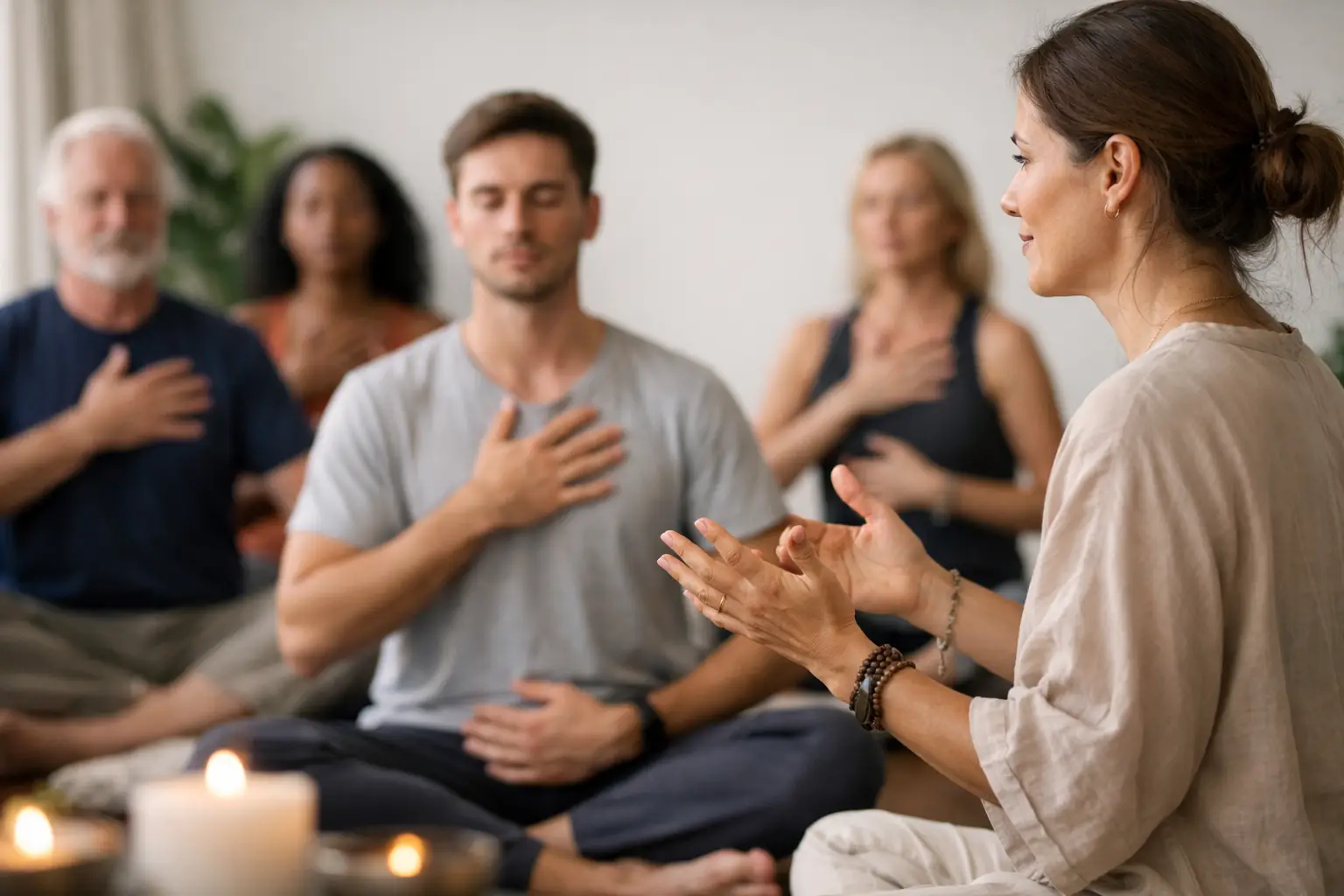
A room can shift in seconds. One person starts breathing more deeply, another begins to cry, someone at the back goes quiet, and suddenly your role is no longer just to guide a technique. It is to hold the whole field. That is why group breathwork facilitation skills matter so deeply. They are not only about leading a sequence of breaths. They are about creating safety, reading energy, setting rhythm, and knowing how to stay steady while others move through release, insight, grief, peace, or joy.
For many wellness professionals, group work is where breathwork becomes both more powerful and more complex. A private session asks you to attune to one nervous system. A group asks you to attune to many, while still offering each person the feeling of being seen. This is where natural intuition helps, but training matters even more.
Why group breathwork facilitation skills are different
In a group setting, the breath amplifies what is already present. That can be beautiful. It can also be unpredictable. The energy of collective breathing often helps people go further than they might in a one-to-one session, because there is a sense of shared permission. People soften faster. Emotions can rise more fully. Insight may come with greater clarity.
Yet the same group field that supports transformation also requires stronger leadership. Timing matters more. Language matters more. The way you open and close the space matters more. If one participant becomes activated, the whole room can feel it. If your guidance is vague, people may lose trust. If your pacing is too intense, some may push beyond what feels resourcing.
Strong facilitators understand this trade-off. Group breathwork can be deeply healing, but only when it is led with discernment. A powerful session is not the same as a dramatic one. Often, the most skilful space-holder is the person who knows how to regulate the room without controlling it.
The foundation of skilful facilitation is safety
Before voice, music, sequencing or emotional depth, there is safety. Not safety as a buzzword, but safety as a lived experience in the body. Participants need to know where they are, what they are stepping into, what choices they have, and how they can respond if something feels too much.
This begins long before the active breathing starts. Clear preparation helps people settle. Contraindications should be understood and honoured. Expectations should be set with honesty rather than hype. If you promise instant breakthrough, you risk creating pressure. If you explain that every experience is valid, from subtle calm to strong release, you help people arrive in their own rhythm.
Safety also means knowing that group sessions are not one-size-fits-all. A room of yoga teachers on retreat may need a different tone from a mixed group at a wellness festival. A circle designed for grief support will not be held in the same way as an uplifting community event. The breath may be the method, but the container must match the people in front of you.
Presence is more important than performance
Many new facilitators worry about sounding polished. They focus on the perfect playlist, the perfect script, the perfect spiritual phrasing. But participants do not need perfection. They need presence.
Presence is what allows you to notice when the group is ready to deepen and when it needs grounding. It helps you sense when your voice should lead and when silence will do more. It lets you stay anchored if someone has an emotional release, rather than reacting from your own discomfort.
This is one of the most overlooked group breathwork facilitation skills. The room responds to your nervous system. If you are rushed, scattered, or trying to impress, people feel it. If you are embodied, calm, and clear, they feel that too. In breathwork, your state teaches as much as your words.
Reading the room without losing the individual
A skilled group facilitator learns to hold two levels at once. There is the collective journey of the room, and there is each participant’s personal process. Favour one too heavily, and something gets lost.
If you become overly focused on individuals, the group field can fragment. If you focus only on the collective, some participants may feel invisible or overwhelmed. The art lies in weaving both together.
This may look like adjusting your guidance when the room feels flat or overly charged. It may mean moving closer to one participant while keeping your voice steady for everyone else. It may mean offering reminders of choice, so people know they can soften the breath, rest, place a hand on the heart, or pause altogether.
The best group facilitators do not assume that intensity equals success. Sometimes the room needs encouragement. Sometimes it needs permission to ease. Knowing the difference comes from experience, humility, and real training.
Structure creates freedom
It may sound paradoxical, but groups often feel safer when the session has clear structure. A well-held beginning, middle and end gives participants something they can trust. Within that shape, emotion and transformation can unfold more naturally.
Opening the space with intention helps people arrive. Explaining the breath pattern clearly reduces uncertainty. Gradually building the journey allows bodies and minds to adapt. Integration at the end is not an optional extra. It is where people begin to make meaning of what has moved.
Without structure, even a warm-hearted facilitator can create confusion. With too much rigidity, the experience can feel mechanical. This is why facilitation is an art. You need enough form to hold the room, and enough softness to respond to what is happening live.
For practitioners who want to lead workshops, retreats, sacred circles or festival sessions, this balance is essential. Professional readiness is not only about being certified. It is about being able to guide a real room of real humans with steadiness and care.
Voice, language and pacing shape the journey
Your voice becomes part of the container. Tone, speed, repetition and word choice all influence how safe and supported people feel. Gentle authority tends to work better than either passivity or force. People want to feel guided, not pushed.
Language matters too. Breathwork can attract spiritual communities, but not every group resonates with the same framing. Heart-centred language can be deeply supportive when it is authentic. It can feel distancing when it is overused or vague. A facilitator needs to speak in a way that welcomes the room rather than performing for it.
Pacing is equally important. If you move too quickly into intensity, some participants may become dysregulated. If you stay too light for too long, the group may never fully enter the process. There is no perfect formula for every room. It depends on the purpose of the session, the experience level of the group, and the emotional charge already present.
Emotional depth requires ethical grounding
Breathwork can bring people into contact with trauma, grief, anger, tenderness, memory and spiritual opening. That is part of its beauty. It is also why ethical facilitation matters.
Holding emotional depth does not mean acting as a therapist unless you are trained as one. It means recognising what breathwork can do, what your scope is, and when someone needs additional support beyond the session. It means not making grand claims about healing. It means respecting consent, boundaries and integration.
For purpose-driven practitioners, this is where professionalism and heart work together. The spiritual path and the practical path are not in conflict. A grounded facilitator knows that clear agreements, solid training, and trauma-aware space-holding do not dilute the magic. They protect it.
This is part of what attracts many people to structured pathways such as Nalu Breathwork. They are not simply looking for a beautiful experience. They want the skills to lead responsibly, to support real transformation, and to step into paid practice with integrity.
What makes a facilitator truly ready
Readiness rarely arrives as a feeling of complete confidence. More often, it arrives as competence paired with humility. You understand your method. You know how to prepare a room. You can guide the breath clearly. You can respond when emotions rise. You can close the session well. And you know where your edges still are.
That last part matters. Mature facilitators keep learning. They reflect after sessions. They notice where they became hesitant, where they over-spoke, where they missed a cue, where they held beautifully. Group work teaches you every time you step into the circle.
If you are a yoga teacher, coach, therapist, bodyworker or retreat leader, adding breathwork to your practice can expand what you offer in profound ways. But the modality asks something of you too. It asks you to become someone who can hold breath, energy, emotion and community at once.
That is not about being the loudest voice in the room. It is about being the steadiness people can lean into while they remember their own inner wisdom.
The most powerful group facilitators are not the ones chasing spectacle. They are the ones who create a space where people feel safe enough to breathe honestly, feel deeply, and return to themselves with more truth than they arrived with.