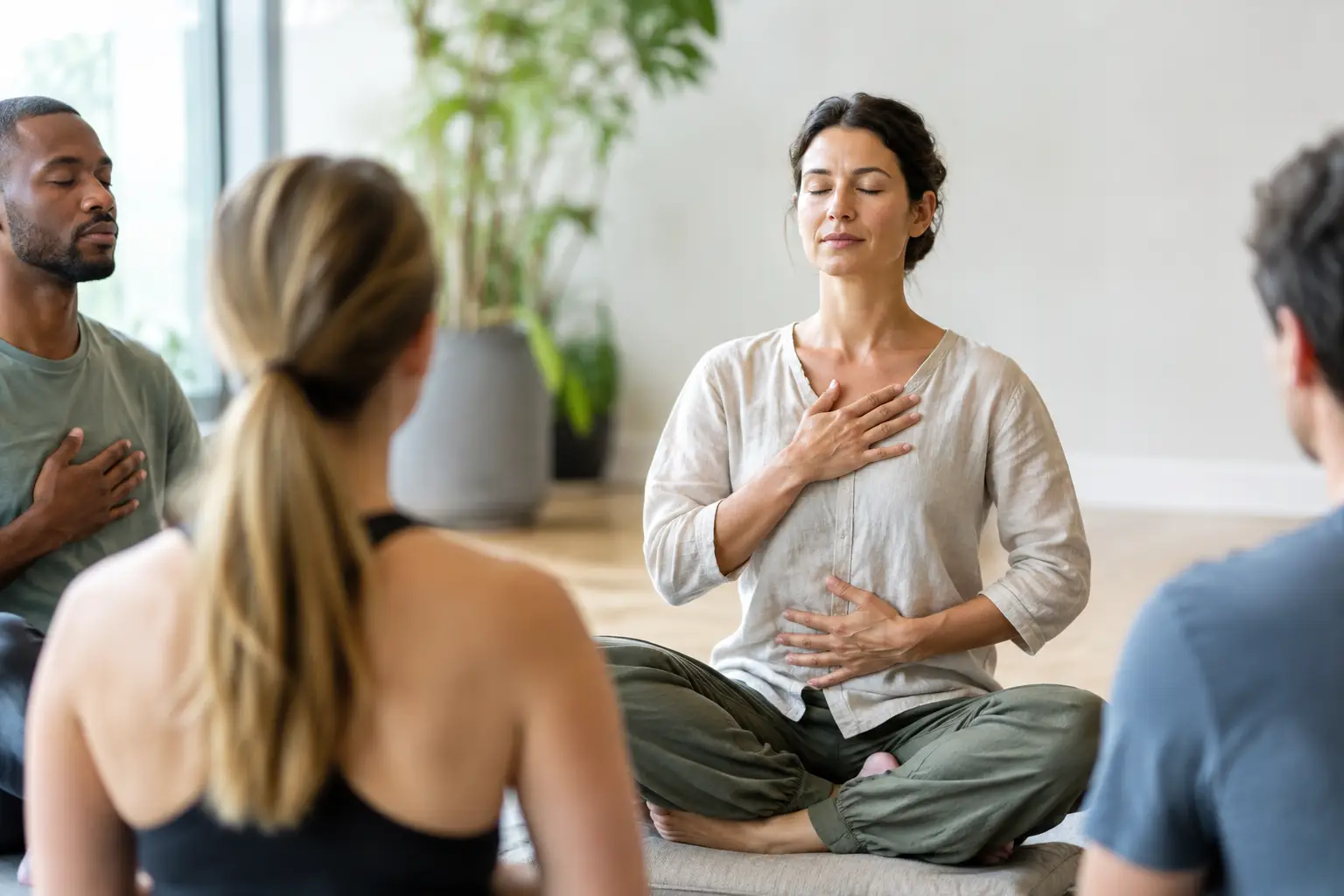
A breathwork qualification can look inspiring on paper, but your ability to hold a client through a real emotional release is built in the room, not on the certificate. The best breathwork training formats give you more than beautiful practices to share. They help you understand safety, develop your own embodied relationship with the breath, practise leading others, and create a professional path you can stand behind.
For yoga teachers, coaches, bodyworkers, therapists-in-training and heart-led entrepreneurs, the right format depends on the practice you want to build. Do you need flexibility around existing clients and family life? Do you learn most deeply through shared experience? Are you ready to lead groups, retreats and sacred circles, or do you first want confidence with one-to-one sessions?
What the best breathwork training formats have in common
The format matters, but it should never be the only deciding factor. A meaningful facilitator training has a clear methodology, supervised or structured practice, guidance on holding emotional experiences, and a realistic understanding of professional scope. Breathwork can bring up powerful sensations, memories and feelings. A facilitator needs to know how to create choice, pace a session, communicate clearly and refer on when someone needs clinical or specialist support.
Look for training that teaches both the experience and the craft. Learning conscious circular breathing for yourself is essential, yet it is different from knowing how to introduce it to a nervous first-timer, support a couple with different needs, or hold a group where one person becomes overwhelmed while the rest of the room remains present.
The strongest courses also make room for integration. A dramatic release is not the same as lasting change. Participants need time to rest, reflect and understand what has moved, while trainees need feedback on the language, pacing and boundaries they bring to each session.
Immersive retreat training: depth through lived experience
An in-person retreat is often the most transformational route for people who want to become confident facilitators quickly. Over several dedicated days, you are away from daily demands and immersed in breathwork as both participant and trainee. You witness how a skilled teacher sets up a room, opens and closes a practice, works with music and touch where appropriate, and tends to the energy of a group.
This format is especially valuable for those planning to lead workshops, retreats, festivals or sacred circles. Group facilitation is not simply a larger version of a private session. It requires attention to the collective field, clear agreements, timing and a grounded presence when different experiences arise at once. Practising with a live soul tribe gives you feedback that a workbook cannot provide.
Retreat learning also creates community. Your fellow trainees may become practice partners, collaborators and a trusted professional Ohana long after the training ends. For many purpose-led practitioners, this belonging is part of what makes the learning land so deeply.
The trade-off is practical. Retreats require travel, uninterrupted time and a greater upfront investment. They can also be emotionally intense. If you are in a season of major stress, grief or caring responsibilities, a gentler paced route may be wiser. Depth does not need to mean rushing your own healing.
Who thrives in a retreat format?
Choose an immersive format if you learn through direct experience, want live mentoring and are preparing to lead groups with confidence. It can be a powerful fit for established wellness professionals who want to add breathwork to their current offering, as well as those ready to begin a new vocation with focused momentum.
Online self-paced study: flexibility with responsibility
Online self-paced breathwork training gives you the freedom to learn around your work, clients and home life. You can revisit demonstrations, pause for reflection and take time to integrate each module before moving forward. For someone balancing a yoga timetable, a therapy placement or a growing business, that flexibility can make certification genuinely achievable.
A thoughtful online programme should still feel structured. Seek clear modules on session design, contraindications and screening, consent, breathwork techniques, integration, professional boundaries and the practical steps for beginning paid work. Video demonstrations and guided practice help, but the content should show you how to make wise decisions, not merely copy a sequence.
Self-paced study works best for disciplined learners who are willing to practise consistently. Set aside time to receive sessions as well as lead them, keep notes on your observations and rehearse your opening and closing language aloud. Confidence grows through repetition. Watching a lesson on space-holding is useful; calmly responding to a client’s uncertainty is a skill that needs embodiment.
The limitation is that online learning can feel solitary if there is no live support or practice community. Before enrolling, ask how feedback is offered and whether there are opportunities to practise leading. A course that provides only recorded content may suit personal exploration, but it may not be enough preparation for professional facilitation.
Hybrid training: the balanced professional pathway
For many future facilitators, a hybrid pathway offers the best balance. Foundational theory and method can be completed online at a pace that supports real life, while in-person training provides live practice, mentoring and the relational depth of shared breathwork.
This approach gives you time to absorb the material before entering a training room. Instead of trying to memorise every element during a retreat, you arrive familiar with the framework and ready to focus on presence. Then, after the in-person component, online resources can support ongoing revision as you begin seeing clients.
Hybrid training is particularly useful if you are adding breathwork alongside an existing profession. A massage therapist may want to build one-to-one sessions first. A coach may want to weave breath awareness into their current work while keeping clear boundaries. A retreat leader may be preparing for larger experiences. The online and live elements allow the learning to meet you where you are, while still asking you to demonstrate real facilitation skills.
Nalu Breathwork combines self-paced learning with immersive certification retreats, teaching conscious circular breathing alongside Ha Breath, Wave Breath and Healing Heart Breath for facilitators who want a heart-based, structured method.
Mentorship and practice-led training: where competence becomes real
Whatever core format you choose, mentorship is the element that turns information into capability. A mentor can hear the difference between language that directs and language that invites. They can help you recognise when you are over-explaining, moving too quickly or trying to rescue a client from an experience they are capable of moving through.
Practice-led learning also helps you find your own voice. You do not need to become a copy of your trainer. You need a reliable framework that lets your warmth, steadiness and professional integrity come through. This matters most when working one-to-one or with couples, where personal dynamics can make the room more complex.
Ask whether the training includes assessed facilitation, peer practice or observed sessions. These are not intimidating extras. They are the bridge between feeling inspired by breathwork and being ready to responsibly charge for a session. If insurance eligibility matters to you, check the requirements with the relevant insurer in your location as part of your decision-making.
How to choose the format that fits your next chapter
Begin with the kind of facilitator you want to be in twelve months. If your vision is to lead intimate private sessions, online study with strong mentoring may be an excellent starting point. If you can already see yourself holding powerful group journeys, an immersive retreat or hybrid course will usually give you more direct preparation.
Then consider your capacity honestly. The best programme is not the most intense one available. It is the one you can fully participate in, practise from and integrate. A course with a smaller initial time commitment can be more valuable than a retreat you attend while exhausted and cannot follow up on.
Finally, look beyond the word certification. Ask what you will actually be able to do when the training ends. Can you screen participants, create consent-based sessions, lead one-to-one, couples and groups, respond to common challenges, and organise paid offerings with appropriate care? Those outcomes are the foundations of a sustainable breathwork practice.
Your training format is not simply a diary decision. It is a choice about how you will learn to hold human beings at tender, courageous moments. Choose the path that asks enough of you to grow, gives you support when you need it, and leaves you ready to share the healing art of breath with a steady heart.