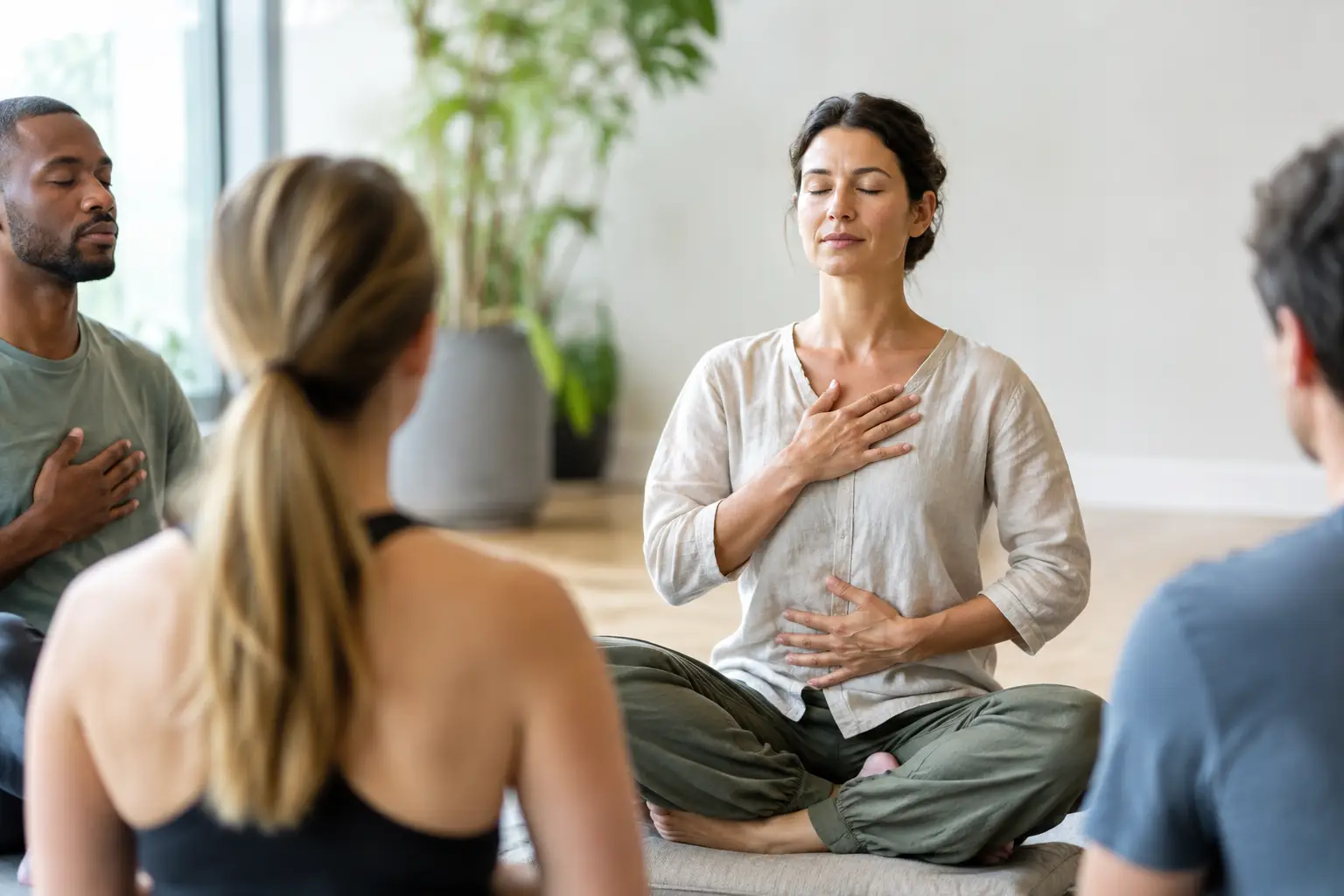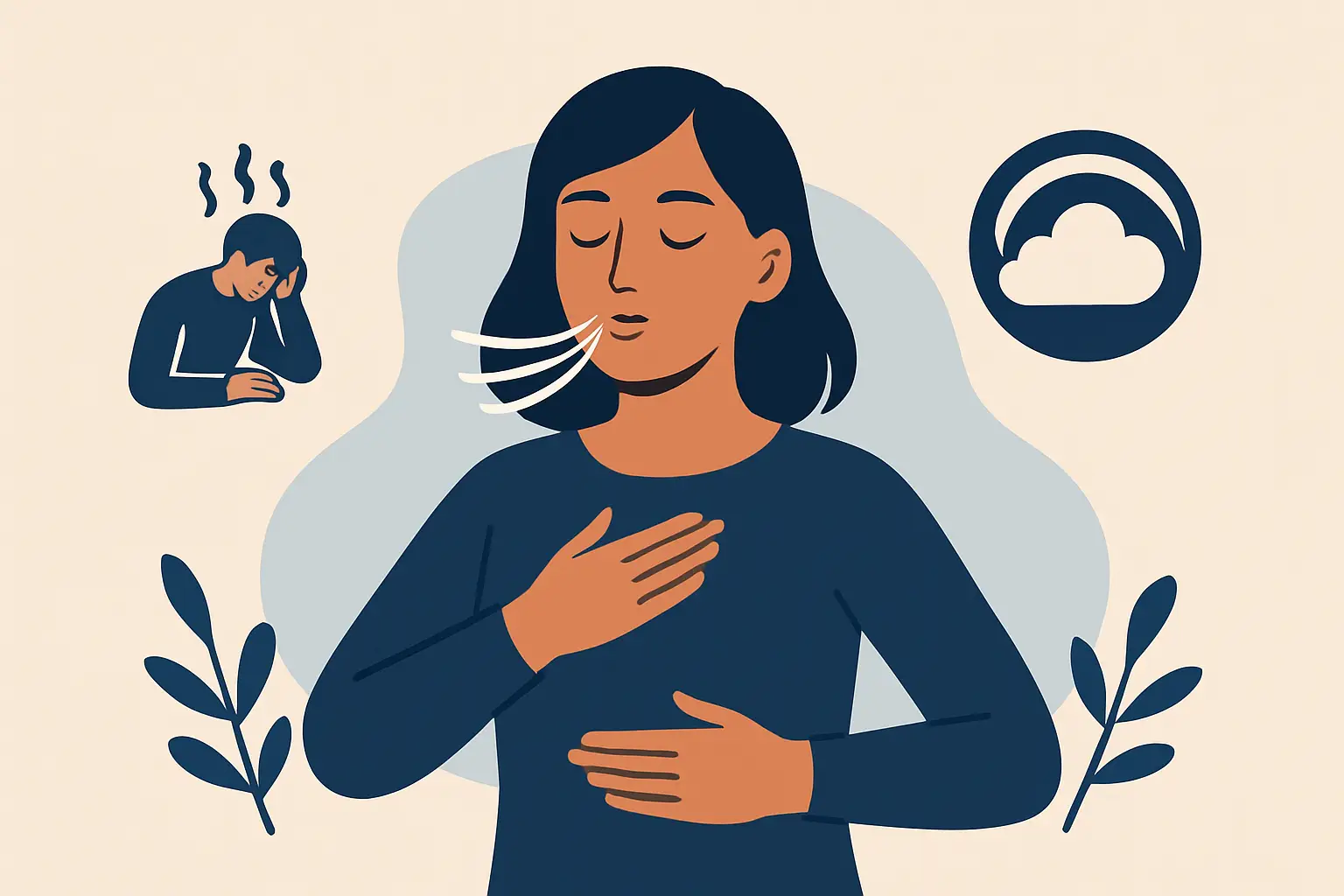
Stress rarely announces itself politely. It creeps into your shoulders while you are answering client messages, tightens your jaw as you plan next week’s classes, and turns a simple decision into a spiralling inner debate at 2am.
If you are a wellness professional or a purpose-led human holding a lot of responsibility, you have probably tried the usual advice: sleep more, cut caffeine, meditate, take a walk. Helpful, yes. But when anxiety is already running your system, your mind can feel like the least cooperative place to start.
Breathwork meets you somewhere more honest: the body. And when practised with care, breathwork for stress and anxiety can be one of the most immediate ways to change how you feel in the moment, not just how you think about it.
Why breathwork for stress and anxiety works so quickly
Anxiety often feels psychological, but it is heavily physiological. Your nervous system is scanning for threat, and your breathing pattern is one of the first places that response shows up. Short, shallow breathing, chest tightness, frequent sighing, and holding the breath are all common when you are stressed.
Here is the empowering part: breathing is also one of the few automatic processes you can consciously steer. When you change your breath, you send updated information to your brain and body. For many people, that shift is felt as more space in the chest, warmth in the belly, or a subtle “I can handle this” returning.
It does depend on the day, though. If you are already close to panic, too much intensity can amplify sensations. The goal is not to force calm. The goal is to create enough safety in your body that calm becomes possible again.
Stress relief is not the only win: breathwork changes your capacity
Most people come to breathwork wanting a tool for the hard moments. But what keeps them practising is what happens afterwards.
With regular, well-held sessions, you may notice you recover faster after a trigger, you can stay present during difficult conversations, and you stop needing to “white-knuckle” your way through your week. For facilitators, this is not only personal wellbeing. It becomes professional integrity. Your nervous system is part of your service.
Breathwork can also open emotional material. That is not a problem to fix – it is often the pathway. Stress and anxiety frequently ride on top of unprocessed grief, pressure, old fear, or a lifetime of over-functioning. Breath gives those layers a way to move.
A gentle starting point: the 90-second reset
When anxiety is high, you want something simple and discreet. This is a good place to begin.
Find a comfortable seat. Let your shoulders drop even one centimetre. Breathe in through the nose for a count of four, then exhale through the nose for a count of six. Keep it smooth, not forced.
That longer exhale is the key. It nudges the body away from fight-or-flight and towards regulation. Do this for 90 seconds. If counting makes you tense, drop the numbers and simply make the out-breath a little longer than the in-breath.
You are not trying to “get rid” of anxiety. You are teaching your system, breath by breath, that you are here and you are safe enough in this moment.
The difference between calming breathwork and transformational breathwork
Not all breathwork is designed for the same outcome, and this matters for safety.
Calming practices are typically slower, nose-breath based, with a longer exhale. They are ideal for daily regulation, sleep support, and bringing you down from stress.
Transformational breathwork practices, including conscious circular breathing, can be more activating. They are often used for deeper emotional release, trauma resolution work, and nervous system re-patterning. In the right container, this can be life-changing. In the wrong container, it can feel overwhelming.
If you are a practitioner considering adding breathwork to your work, this is where professionalism begins: knowing which tool to use, when to use it, and how to hold what arises.
A simple practice for anxious overthinking
Overthinking is often a sign of the body searching for control. Try this for three minutes when your mind is looping.
Breathe in through the nose, then exhale through lightly pursed lips, as if you are gently cooling soup. Keep the exhale steady and slightly longer than the inhale.
The subtle resistance on the out-breath can help you slow down without needing to mentally “stop thinking”. You may still have thoughts, but they often lose their sharpness.
If you notice dizziness, tingling, or discomfort, return to normal breathing and place a hand on your heart or belly. More intensity is not more healing.
When to practise, and when to pause
Breathwork is powerful because it works with real physiology. That also means there are times to take extra care.
If you are exhausted, burnt out, or feeling fragile, choose gentler regulation practices rather than anything stimulating. If you have a history of panic attacks, work slowly and consider support from a trained facilitator. If you are pregnant, have cardiovascular concerns, unmanaged high blood pressure, glaucoma, or a history of seizures, you should seek medical guidance and work only with practices that are appropriate for your situation.
And if you are currently in an acute mental health crisis, breathwork is not a substitute for professional care. It can be a supportive companion, but you deserve the right level of support.
What a well-held breathwork session can shift
When stress and anxiety have been chronic, your baseline can become “tight but functional”. You might still be teaching classes, seeing clients, raising children, building a business – yet inside you are bracing.
A well-held session can help your system complete stress cycles that never finished. You may experience shaking, tears, heat, spontaneous sighs, or a deep sense of relief. These are not signs something has gone wrong. They are often signs your body is releasing what it has been carrying.
The trade-off is that deeper work can bring up tenderness. It is not always blissful. Sometimes it is honest. The container matters: skilled space-holding, clear consent, grounding, and integration support.
If you want to facilitate breathwork, start with your own nervous system
Many of our community are already healers in some form: yoga teachers, coaches, therapists, bodyworkers, retreat leaders. Breathwork can be a natural next step because it is both simple and profound.
But facilitation is not just guiding breaths. It is reading a room, tracking nervous system cues, understanding contraindications, supporting emotional release without rescuing, and knowing how to bring someone back to safety.
When you begin to practise breathwork for stress and anxiety personally, you are also learning what your future clients will need: permission to go slowly, a method that has structure, and a facilitator who can hold depth without drama.
For those feeling the call to become professionally trained, Nalu Breathwork offers education and certification grounded in heart-led practice and clear methodology, designed to support you to confidently lead 1:1, couples, and group sessions. If that speaks to your path, explore the training options at https://Nalubreathwork.com.
Making it real: how to build a practice you will actually do
Consistency beats intensity, especially for anxious systems. The most effective breathwork routine is one you can keep when life is full.
Choose one anchor moment each day. It might be before you open your laptop, after the school run, or when you get into bed. Do two minutes of longer exhales. Let it be almost disappointingly simple.
Then, once or twice a week, add a slightly longer session of 10-20 minutes where you practise in a quiet space and allow emotions to move gently. If you notice you keep avoiding stillness, that is information, not failure. Start smaller. Even three mindful breaths done with sincerity can interrupt a stress spiral.
Over time, you may find you are not using breathwork only when things go wrong. You are using it to live from a steadier centre.
Closing thought
Your breath is not asking you to become someone calmer, more evolved, or more “together”. It is simply offering you a way back to yourself, one honest exhale at a time.