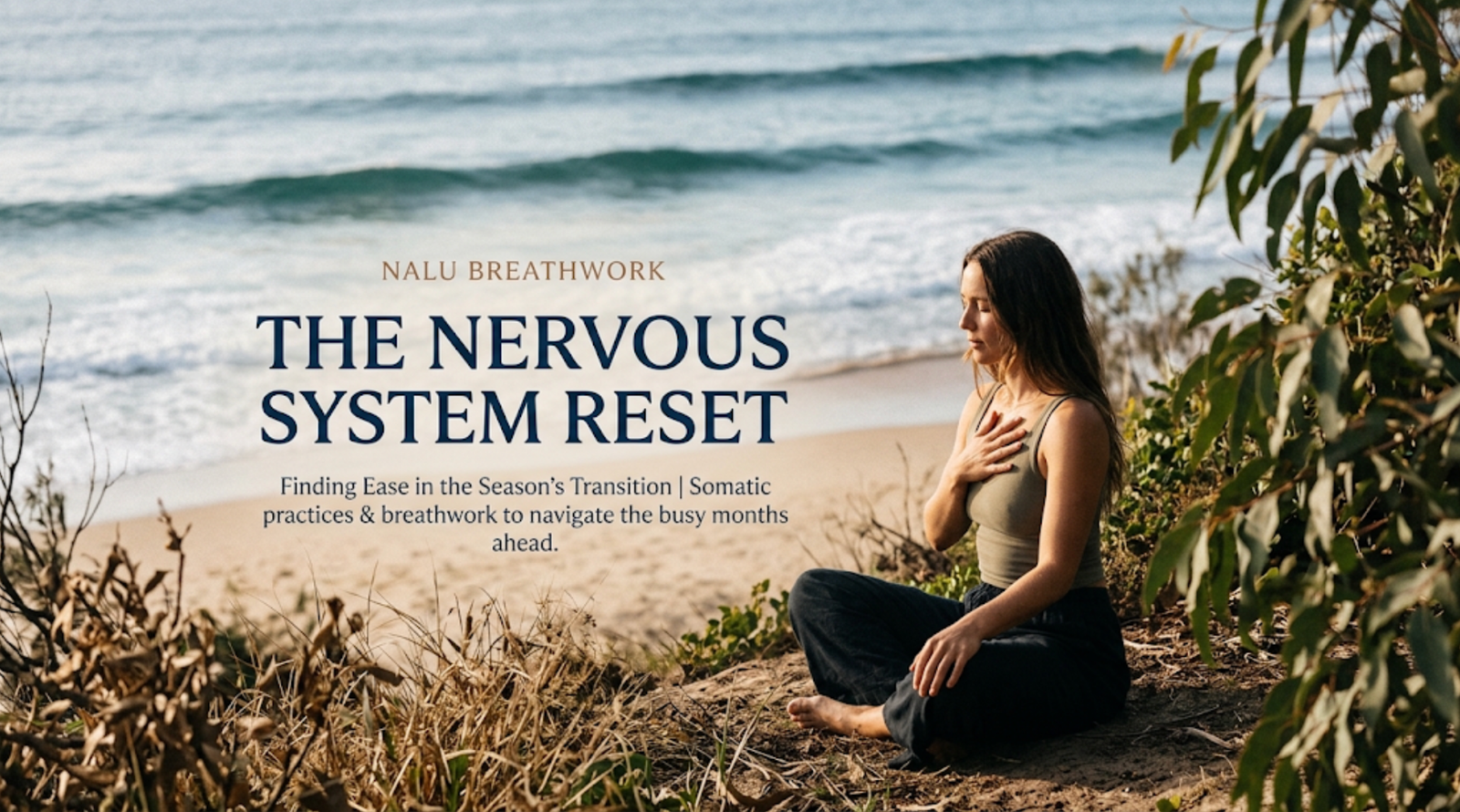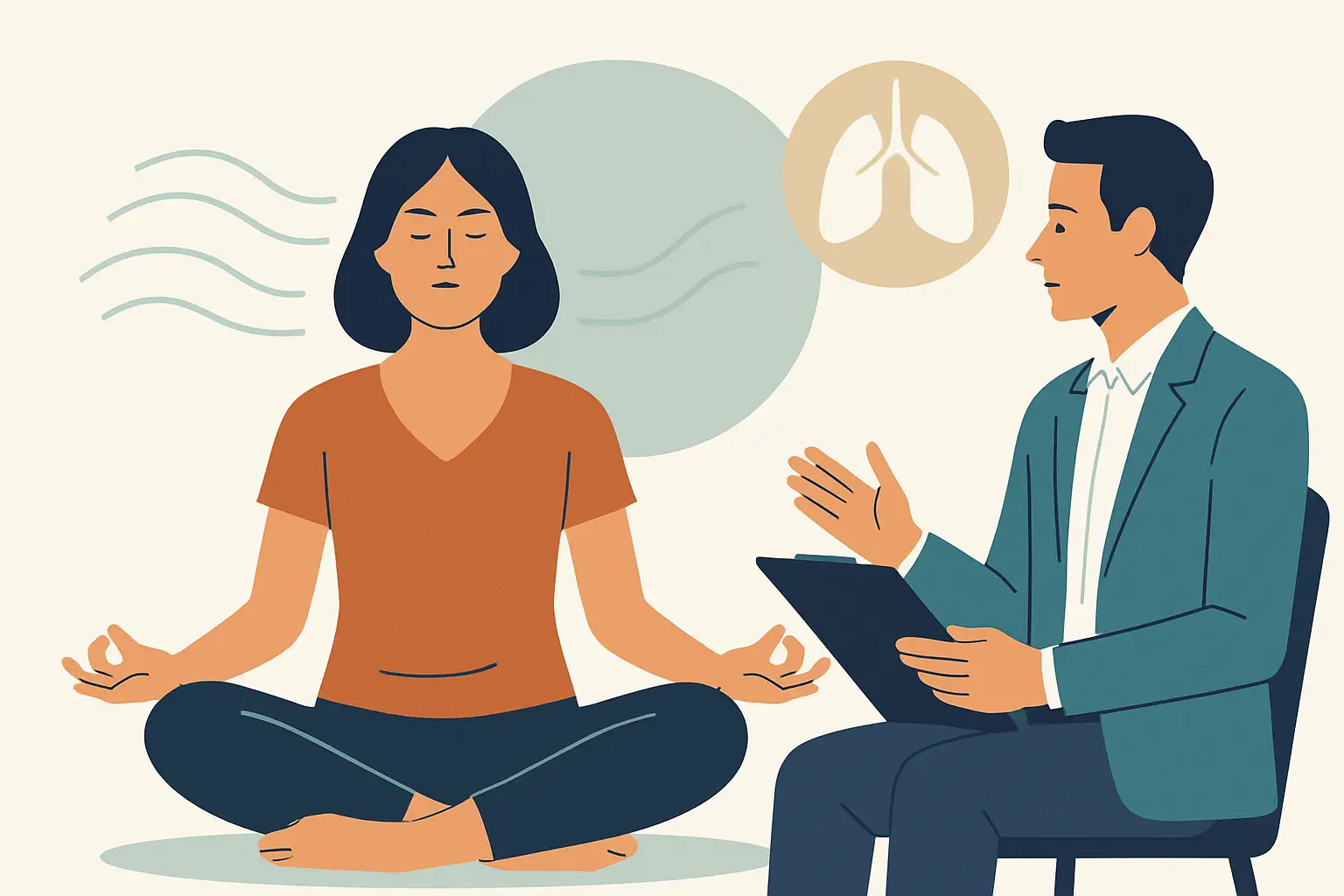
You already know what it feels like when a client is talking, analysing, trying to “figure it out” – and their body is quietly telling a different truth. The shallow breath. The tight jaw. The shoulders up by the ears. The brave smile paired with a nervous system that is clearly braced.
This is where breathwork changes the coaching room.
Not as a trendy add-on. Not as a quick fix. As a direct way to work with the body’s language – so your client can move from insight to integration. But if you are a coach, a therapist-in-training, a yoga teacher, or a space holder who wants to bring breathwork into your work, there is a question that matters more than “Which breath pattern is best?”
Are you trained to hold what breathwork can open?
Why breathwork belongs in modern coaching
Coaching is often brilliant at clarity, accountability, and forward movement. Breathwork is brilliant at contact – with sensation, emotion, memory, and the parts of us that do not respond to logic alone.
When clients breathe consciously, they are not just “calming down”. They are creating internal conditions where the system can process. For some people, that looks like deep peace and spaciousness. For others, it looks like tears, trembling, anger, grief, laughter, or a sudden, wordless realisation. Those moments can be profoundly healing, and they can also be messy.
This is why breathwork training for coaches is not simply about learning a technique. It is about learning how to work responsibly with altered states, emotional release, and the reality that your client’s nervous system will lead the session more than their to-do list.
There is also a practical reason coaches are turning towards breathwork: clients want felt change. Many people are tired of talking in circles. They want to feel lighter, freer, more alive – and they want it to translate into better relationships, clearer boundaries, and more resilient leadership.
What breathwork training for coaches should actually give you
A good training should leave you more confident, not more performative. You should come out knowing how to lead a session with structure, adapt in real time, and make decisions that prioritise safety over intensity.
At minimum, you want training that gives you three things.
First, a clear method you can reliably deliver. Breathwork is not one thing. Some styles are meditative and gentle. Others are activating and cathartic. If you are a coach, you need to know what you are offering, why it works, and when it is not appropriate.
Second, real space-holding skills. This means knowing how to set the container, how to use language that keeps clients embodied, and how to respond when emotions escalate. It also means knowing your scope. Coaches are not therapists unless they are trained as such, and breathwork can blur lines if you are not grounded in ethics.
Third, professional readiness. Many coaches want to run paid 1:1 sessions, couples sessions, workshops, retreats, and group circles. Training should cover facilitation logistics, client screening, contraindications, aftercare, and the basics that support insurance eligibility where applicable.
If a training promises you “powerful breakthroughs” but does not teach you how to work with dysregulation, trauma responses, or strong emotional release, that is a red flag. Power without skill is not service.
The real shift: from coaching minds to supporting nervous systems
Coaching clients often arrive with a problem they can articulate. Yet their patterns are often held in the body.
A client may say they struggle with confidence, but their breath collapses every time they speak about visibility. Another may say they feel stuck, but their ribcage barely moves when they talk about grief. Breathwork can meet these patterns directly, giving the client an experience of safety, agency, and emotional movement.
This is the trade-off, and it is important to name it honestly. When you include breathwork, sessions can become less predictable. You might plan a neat 60-minute arc and discover the client needs five minutes of gentle resourcing before you even begin. You might intend a short breath practice and find the client touching something tender that requires slower pacing and more aftercare.
If you like neat outcomes, breathwork will stretch you. If you are called to work with the full human experience – mind, body, heart, spirit – breathwork will deepen your work.
What to look for in a training (and what to be wary of)
The breath is simple. Facilitating breathwork is not.
Look for training that teaches you how to screen clients and understand contraindications. Breathwork can be inappropriate for some people, including those with certain cardiovascular concerns, unmanaged mental health conditions, or a history that suggests a strong risk of overwhelm. A reputable course will not treat this as fine print.
Look for trauma-aware language and practices. Trauma-informed is a term that gets thrown around, but in practice it means you know how to create choice, how to track nervous system cues, and how to bring a client back to the room if they start to dissociate. It also means you do not chase catharsis as proof of success.
Look for supervised practice. You do not learn to facilitate by watching videos alone. You learn by guiding real people, receiving feedback, and building the muscle of presence.
Be wary of trainings that treat breathwork as a guaranteed “release” button. Some sessions are subtle. Some are huge. Both can be transformational. The goal is not drama. The goal is integration.
Bringing breathwork into your coaching in a way that feels clean
Coaches sometimes worry that adding breathwork will dilute their brand or confuse their clients. It does not have to.
If your coaching is performance and leadership focused, breathwork can support regulation, emotional agility, and clearer decision-making. If your coaching is relationship focused, breathwork can soften defences and help clients practise safety in their own bodies. If your work is spiritually oriented, breathwork can become a direct path to inner guidance and heart connection.
The key is to be explicit about how you use it.
Some coaches weave in short breath practices as nervous system tools at the start or end of sessions. Others offer stand-alone breathwork sessions alongside coaching programmes. Some run group breathwork circles as community touchpoints, then invite deeper 1:1 coaching for integration.
It depends on your clients, your scope, and your capacity. Group work can be powerful and scalable, but it requires stronger facilitation skills because you are holding multiple nervous systems at once. 1:1 work can be more tailored, but it may bring more complex personal material to the surface.
Method matters: conscious circular breathing and beyond
One of the most commonly taught foundations for transformational breathwork is conscious circular breathing – a connected, continuous breath that can shift state and bring buried emotion into awareness.
Used well, it can help clients move through stress and grief, access insight, and feel their own life force again. Used carelessly, it can push people into intensity without support.
That is why method and pacing matter. A solid training will teach you how to modulate intensity, how to use music and language skilfully, and how to work with different bodies and backgrounds.
If you feel called to a lineage or cultural root, honour that too. Some trainings carry specific philosophies and practices that shape the way you facilitate – not just what you do, but how you hold the work. For many coaches, this is the missing piece: a modality that is not only effective, but also heart-led.
For example, Nalu Breathwork offers certification rooted in a Hawaiian-inspired method set, teaching facilitators to lead 1:1, couples, and group sessions with strong emphasis on safety, emotional depth, and professional readiness – you can explore their pathway at https://Nalubreathwork.com.
Online course or in-person retreat: what suits you now?
This is one of the biggest decisions coaches make.
Online breathwork teacher training is flexible and can be a beautiful option if you are building your skills alongside a busy practice. You can learn the theory, practise consistently, and revisit content as you grow. The risk is that you stay in your head if there is not enough live practice and feedback.
In-person retreat training is immersive. You step out of daily life, practise repeatedly, and often experience your own breakthroughs that make you a better facilitator. The risk is that it can feel intense, and you will still need ongoing practise afterwards to integrate what you have learned.
Many coaches do well with a blended approach: learn at home, then attend an immersion for embodiment and confidence. Whatever you choose, make sure you have a pathway to practise with real humans, not just your notes.
The ethics of power: what you are responsible for as a facilitator
Breathwork can create devotion. Clients may feel you “changed their life” after a single session. That is beautiful, and it is also a moment to stay grounded.
Your role is not to become a guru. Your role is to create a clean container where clients meet themselves.
That means clear consent, clear boundaries, and clear aftercare. It means you do not promise healing you cannot guarantee. It means you know when to refer out, and you respect other professionals.
It also means doing your own work. Breathwork facilitation is not only a skill set. It is a level of presence. The more you have met your own fear, grief, and control patterns, the safer you will be when someone else meets theirs.
A simple way to know you are ready to train
If you feel a genuine pull – not just to use breathwork as a tool, but to serve people through it – that matters. The calling is often quiet at first. You might notice it when you witness a client exhale for the first time all week. You might notice it when your own breath carries you through a hard season and you think, “More people need this.”
Then bring discernment.
Ask yourself if you want breathwork to be an occasional add-on, or a core part of your practice. Ask yourself whether you are willing to learn the boring parts as well as the blissful ones: screening, contraindications, pacing, and the humility of being a student again.
Because when breathwork is held with skill, it does something coaching alone sometimes cannot. It gives the body a voice. It gives the heart room. And it reminds both you and your client that transformation is not always something you think your way into.
A helpful closing thought: let your standard be simple – choose training that teaches you how to create safety first, and trust that depth will follow when it is truly time.