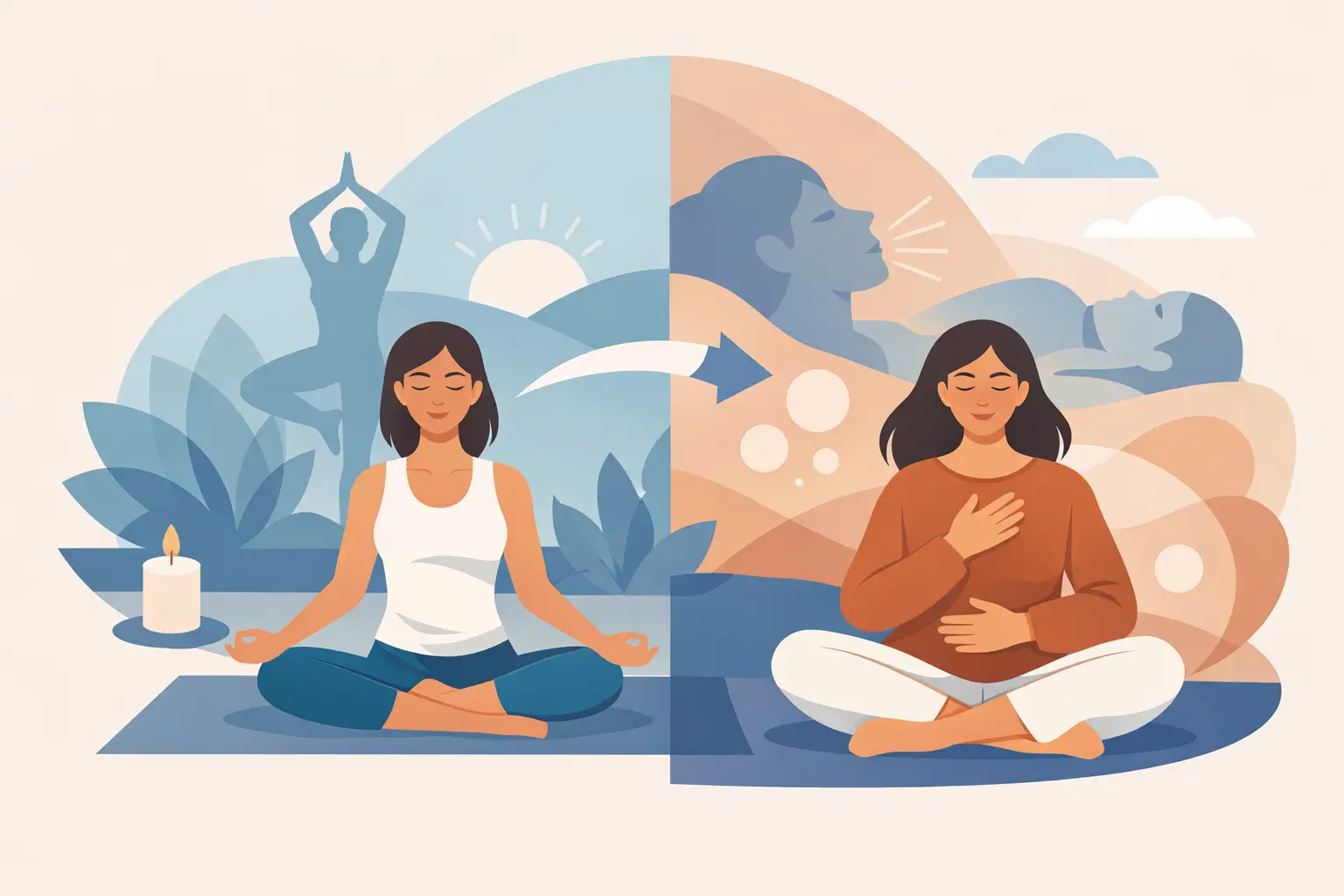
You can feel it in the room before anyone says a word. The asana lands, the class softens, and then something deeper starts asking to come through. For many practitioners, the move from yoga teacher to breathwork facilitator begins there – in that moment when breath stops being a cue and becomes the practice itself.
This shift is not about leaving yoga behind. It is about listening to what your students may already be showing you. Perhaps they stay after class to talk about anxiety, grief, overwhelm, or a sense that they are holding something they cannot stretch out. Perhaps you have felt it in your own body too. Breathwork can meet that space in a direct, profound way, but it asks for a different level of training, responsibility, and presence.
Why move from yoga teacher to breathwork facilitator?
Yoga teachers already understand that transformation does not happen through shape alone. You know how to hold rhythm, guide attention, read energy in a room, and invite people back into their bodies. Those are powerful foundations. Yet breathwork often reaches places that movement does not touch so quickly.
For many teachers, the attraction is both personal and professional. On a heart level, breathwork offers a way to support emotional release, nervous system regulation, grief processing, and inner reconnection. On a practical level, it can expand your work beyond weekly classes into 1:1 sessions, couples work, workshops, retreats, festivals, and sacred circles.
That said, it is not a simple add-on. Breathwork is not just pranayama with new branding. A full facilitation path involves learning how to guide altered emotional states safely, how to recognise when a client needs grounding rather than intensity, and how to hold space without pushing for catharsis.
What carries over from yoga teaching
If you already teach yoga, you are not starting from zero. Much of what makes a trusted yoga teacher also makes a strong facilitator. Your understanding of breath-body awareness, pacing, consent, tone of voice, and class leadership all matter here.
You likely already know how to create a container. You know that people do not open because the playlist is beautiful or the room looks serene. They open when they feel safe enough. That instinct is gold in breathwork.
Embodiment is another major strength. A good yoga teacher does not teach from theory alone. They teach from lived practice, and breathwork demands the same. Clients can feel the difference between someone who has memorised a method and someone who has done their own inner work.
Then there is language. In both yoga and breathwork, the words you choose shape the nervous system. Clear invitations work better than performance. Grounded presence works better than trying to sound mystical.
Where yoga training is not enough
This is where honesty matters. Teaching breath awareness in a vinyasa class is not the same as facilitating a dedicated breathwork session. Conscious circular breathing, for example, can bring up strong physical sensations, emotional releases, memories, tears, resistance, and moments of deep peace. Without the right training, a teacher can easily overestimate what they are equipped to hold.
The main gap is usually safety. You need to understand contraindications, session structure, trauma sensitivity, integration, and what to do when someone becomes activated, dissociated, frightened, or emotionally flooded. You also need to know how to set expectations well before the session begins.
There is also a professional difference. If you want to offer paid breathwork sessions with confidence, your training should prepare you not only to guide the experience but to do so in a way that supports insurance eligibility and real-world facilitation standards. Heart-centred work still needs clear frameworks.
From yoga teacher to breathwork facilitator: what training should include?
Not all trainings are equal, and this is worth taking your time over. A weekend of inspiration may deepen your personal practice, but it may not prepare you to guide others professionally.
Look for a training that teaches more than technique. You want a pathway that covers space holding, ethics, contraindications, emotional release, integration, and how to facilitate different session types. Group sessions and 1:1 work require different skills. Couples sessions bring another layer again.
Method also matters. A clear modality gives you something solid to stand on when clients present with stress, grief, trauma, or simply the longing to reconnect to themselves. If the training includes a lineage or philosophy, ask whether it genuinely informs the practice or is just decoration.
For many yoga teachers, the best training is one that honours both healing and professionalism. That means learning how to hold a profound journey while also understanding session flow, client care, and the practical realities of building a paid offering.
The inner shift matters as much as the certificate
A lot of people ask, “Can I do breathwork training if I already teach yoga?” Usually, yes. The better question is whether you are ready to be changed by the process yourself.
Becoming a facilitator is not only about gaining another skill. It is about deepening your capacity to stay present when someone is in joy, grief, shaking, silence, resistance, or release. It asks for maturity. It asks for humility. And it asks you to keep meeting your own edges so that your clients do not have to carry them for you.
That can feel stretching, especially if you are used to leading classes where the structure is more familiar and contained. But it is also what makes the work so meaningful. The move from yoga teacher to breathwork facilitator often awakens a new level of vocation. You are no longer only guiding movement. You are learning to hold transformation in real time.
How breathwork can expand your work
There is a reason so many wellness professionals are adding breathwork to their toolkit. It meets a growing need. People are looking for practices that help them feel, release, regulate, and reconnect without needing years of preparation before they experience a shift.
For yoga teachers, this can create a more spacious and sustainable professional path. Instead of relying only on full group timetables, you may choose to offer private sessions, themed workshops, retreats, and collaborative events. Some teachers weave breathwork into existing communities. Others create an entirely new branch of their business.
It depends on your calling. If you love intimate client work, 1:1 facilitation may suit you beautifully. If you come alive in community settings, group journeys and sacred circles may feel like home. If you already lead retreats, breathwork can bring greater emotional depth to that space.
What matters most is that the modality fits your values and your nervous system. Not every yoga teacher wants to hold intense emotional work, and that is fine. But if you do feel called, proper training can help you meet that calling with steadiness rather than guesswork.
Choosing a path with both heart and structure
The most trusted facilitator trainings combine spiritual depth with grounded competence. That balance is essential. Clients need to feel your heart, but they also need to know they are in safe hands.
A strong training should leave you able to guide sessions with clarity, adapt to different people and settings, and communicate the work in a way that is both accessible and responsible. It should not leave you wondering whether you are really ready.
This is one reason many yoga teachers are drawn to certification pathways that include immersive learning as well as online study. Retreat-based training can be powerful because you live the work in community, while self-paced modules give you time to integrate and return to the material. Nalu Breathwork offers both, which can be especially supportive if you want a training journey that is experiential, structured, and professionally relevant.
A new chapter, not a new identity
You do not have to abandon the teacher you have already become. Often, the strongest breathwork facilitators are the ones who bring their yoga roots with them – the reverence for breath, the respect for the body, the understanding that healing cannot be forced.
This next step is not about being more impressive. It is about becoming more aligned with the work that is asking to move through you. If your heart has been nudging you from the edge of the mat towards something deeper, trust that nudge enough to explore it properly.
Your students do not need another polished performance. They need a grounded guide who has done the work, honours the power of the breath, and knows how to hold a room with wisdom as well as warmth. If that feels like your path, let this be the season you answer it.