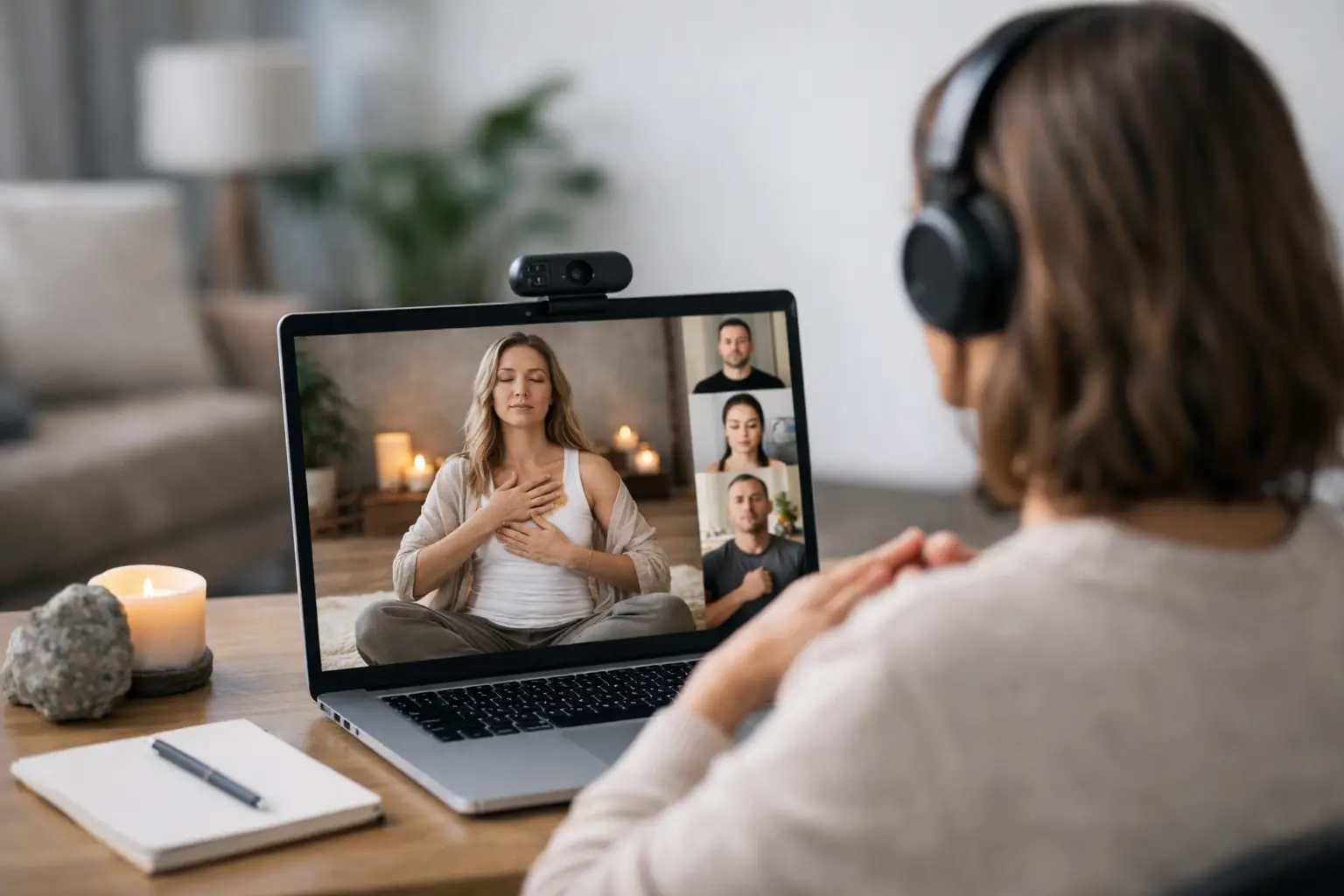
A powerful online breathwork session does not begin when everyone clicks Join. It begins in the way you prepare the room they cannot see, the pace of your voice, the safety of your structure, and the trust your clients feel before the first breath is taken. If you are learning how to run breathwork sessions on Zoom, that is the real work – not just the tech, but the energy, boundaries and facilitation that allow people to go deep from their own homes.
Online breathwork can be profoundly effective. In some cases, it is even more supportive than in-person work because people are already in a familiar space, with their own blanket, water, and privacy afterwards. At the same time, Zoom sessions ask more of the facilitator. You cannot rely on the energy of the room alone. You need stronger preparation, clearer instructions, and a trauma-aware approach to emotional release and integration.
Why Zoom breathwork needs a different approach
Running breathwork online is not simply copying your in-person session and placing it on a screen. The format changes how you read the room, how quickly you can respond, and how much responsibility the client holds for their own environment.
In a studio, you can notice subtle shifts in posture, breathing rhythm, or overwhelm almost instantly. On Zoom, a camera angle may hide those cues. Some people may switch their camera off during the active breathing phase. Others may have family in the next room, unstable internet, or a space that does not fully support surrender. That does not make online facilitation lesser. It simply means your session design needs to carry more of the safety.
This is especially true if you are holding conscious circular breathing or any style that can bring forward strong sensation, memory, grief, or catharsis. A heart-centred facilitator does not chase intensity for its own sake. You are creating a container where release is possible, choice is clear, and people feel guided rather than pushed.
How to run breathwork sessions on Zoom safely
Safety begins before the session itself. Your booking flow, welcome email and pre-session communication should set the tone. Let clients know what they need: a quiet space, headphones or a speaker, water, tissues, a blanket, and somewhere comfortable to lie down. Ask them to arrange privacy where possible and to avoid driving or planning anything demanding straight afterwards.
You also need screening. That can be a health form, waiver, and a short check-in before someone joins a group or 1:1 journey. Certain physical and mental health conditions may require medical clearance, a gentler approach, or referral elsewhere. This is one of the biggest marks of a professional facilitator. Loving space-holding includes knowing when not to proceed, or when to modify.
At the start of the call, orient everyone carefully. Explain the breathing pattern, the likely sensations, and what choices they have if anything feels too much. Tell them how to get your attention. Make sure they know they can slow down, return to natural breathing, place a hand on the heart, open their eyes, or sit up if needed. When people understand that they are not trapped in the process, they usually relax more deeply into it.
Set clear agreements before anyone starts breathing
Online sessions work best when expectations are simple and explicit. Let clients know whether cameras stay on, when they may switch to speaker view, and whether the session will be recorded. In most cases, the active breathwork portion should not be recorded. People need emotional freedom, not the sense that their release is being archived.
It also helps to name the culture of the space. Invite confidentiality, self-responsibility and kindness. If you are holding a group, remind everyone that each journey is their own. Comparison can take people out of their bodies very quickly.
Your Zoom set-up matters more than you think
The technical side of online facilitation is not glamorous, but it shapes the entire experience. Your sound quality matters more than your camera. If clients cannot hear your voice or the music cleanly, they will struggle to stay with the process. Use a reliable microphone and test your settings in advance, especially if you are sharing music.
Keep your camera stable and your background uncluttered. Soft lighting and a calm visual field help people settle. Your internet connection should be as strong as possible. If your connection often drops, clients will feel that instability in their nervous system, even if they do not say so.
You also need to think like a guide, not just a host. Position your notes where you can glance at them without losing eye contact. Have your playlist ready and timed. Silence notifications. Close other tabs. The cleaner your set-up, the more fully you can be present.
Audio, music and pacing
Music can support the emotional arc of a breathwork journey, but on Zoom it needs care. Music that is too loud can drown your guidance. Music that is too complex can muddy the experience. Choose tracks that support the rhythm of the session and leave enough space for your voice.
Your pacing also changes online. Speak a little more clearly and a little less than you think you need to. Too much talking pulls people back into the mind. Too little can leave them feeling abandoned. The sweet spot is calm, grounded and intentional.
Structure the session so clients feel held
If you want to know how to run breathwork sessions on Zoom in a way that feels powerful and professional, pay close attention to structure. A clear flow helps the body feel safe.
Begin with arrival. Let people land, share briefly if appropriate, and connect to why they are here. Then move into orientation and resourcing. This could include grounding, body awareness, intention setting, and reminding them of their choice points.
From there, guide the active breathing phase with steadiness. Avoid performing. Breathwork is not about impressing people with spiritual language. It is about helping them stay connected to sensation, emotion and breath. Use simple prompts. Encourage curiosity. Let the breath do the work.
After the peak, allow enough time for rest and integration. This is where many newer facilitators rush. The stillness after the breathing is often where insight lands and the nervous system begins to reorganise. Do not cut that short because the clock feels tight.
Close gently. Invite journalling, a few words of sharing, or a hand on the heart. Offer practical aftercare, such as hydration, rest, and avoiding overstimulation. Integration is part of the session, not an optional extra.
Group sessions and 1:1 sessions are not the same
A Zoom group breathwork circle needs stronger group agreements, simpler instructions and more general pacing. You are holding many nervous systems at once, and you will not be able to track each person closely throughout. That means your screening and opening orientation become even more important.
A 1:1 session allows for more nuance. You can tailor the language, check in more directly, and adapt in real time. This can be especially supportive for clients moving through grief, stress, or a tender life transition. It also places more demand on your attunement because there is nowhere to hide behind the group field.
Couples sessions sit somewhere in between. They can be beautiful, but they need thoughtful framing. Each person must have space for their own process without becoming responsible for the other person’s emotions in the moment.
Presence is your real technology
The best online facilitators are not the ones with the fanciest set-up. They are the ones who know how to regulate themselves, hold clear boundaries, and stay deeply present through whatever arises. Clients can feel that through a screen.
This is where training matters. Technique alone is not enough. To lead breathwork professionally, you need to understand contraindications, emotional release, nervous system responses, and how to guide people back to safety without drama. You also need practice – not just breathing yourself, but leading others with competence and care.
For purpose-led practitioners building a healing business, Zoom opens real possibility. You can support clients across regions, offer workshops without venue costs, and build a body of work that fits modern life. But reach should never come before responsibility. A spacious online session is still sacred work.
If you are called to lead, start by becoming excellent at the basics. Create a safe container. Speak with clarity. Trust the breath. And remember that even through a screen, people are not looking for perfection. They are looking for someone steady enough to walk beside them as they return home to themselves.