A racing mind rarely responds to being told to calm down. What it does respond to is a clear, physical signal of safety: your feet against the floor, the weight of your body in the chair, and a breath that asks for nothing more than one steady moment. These five breathwork grounding techniques are simple ways to come back to yourself when life feels loud, fast or emotionally charged.
Grounding is not about forcing a particular state or breathing perfectly. It is about gently orienting towards the present. For wellness professionals, coaches and space holders, these practices can also become valuable tools for opening or closing a session, helping a client settle before deeper work, or bringing a group back into their bodies after an emotional release.
Before you begin: choose comfort over intensity
Grounding breathwork should feel accessible. There is no prize for taking the biggest breath, holding for the longest count, or pushing through dizziness. Let the breath remain soft, preferably through the nose if that is comfortable, and stop if you feel light-headed, numb, overwhelmed or unwell.
If you are in a period of acute distress, panic, dissociation, or you have a health condition that affects your breathing or heart, choose the gentlest option and seek appropriate professional support where needed. Deep conscious circular breathing can be a powerful practice, but it is not always the right starting point. A grounding practice works best when it leaves you feeling more here, not less.
Five breathwork grounding techniques to practise
1. The extended exhale
The easiest place to begin is often with a slightly longer out-breath. Inhale naturally for a count of three or four, then exhale slowly for a count of five or six. Continue for six to ten rounds, without straining to meet the numbers.
A longer exhale can invite the body towards down-regulation, particularly when you have been rushing between clients, staring at a screen, or carrying the residue of a difficult conversation. Keep your jaw loose and let your shoulders drop as you breathe out. The exhale is an invitation to soften, not a demand to relax.
This technique is especially useful for facilitators before holding a session. Rather than arriving in the room with your own nervous system in overdrive, take two minutes to arrive first. Your presence is part of the container.
2. Feet-to-earth breathing
Stand with both feet hip-width apart, or sit with the soles of your feet planted on the floor. Notice where your heels, the balls of your feet and your toes meet the ground. Then breathe in gently, sensing the length of your spine. As you breathe out, imagine your weight settling down through your legs and into the earth.
You do not need to visualise roots if imagery does not resonate with you. The practical sensation of pressure beneath your feet is enough. On each exhale, quietly name one thing you can feel: heel, sock, carpet, floorboards, shoes, warmth, coolness.
This is a helpful practice for people who live in their heads or feel floaty after meditation, bodywork or a powerful emotional experience. It combines breath with sensory attention, giving the mind a concrete place to land.
3. Square breath with a softer hold
Square breathing follows four phases: inhale, pause, exhale, pause. Begin with a comfortable count of three for each phase. Breathe in for three, pause for three, breathe out for three, and rest for three. Repeat for four or five rounds.
The pauses are optional. If holding the breath creates pressure, anxiety or a sense of bracing, remove them. You can simply inhale for three and exhale for three, allowing the rhythm to be steady and even. Grounding is never about overriding the body’s honest response.
For a client or group, this breath can create a shared pace without requiring anyone to disclose what they are feeling. It is quietly organising. The rhythm gives the nervous system something predictable to follow, which can be deeply reassuring when emotions feel unpredictable.
4. Hand-on-heart and belly breathing
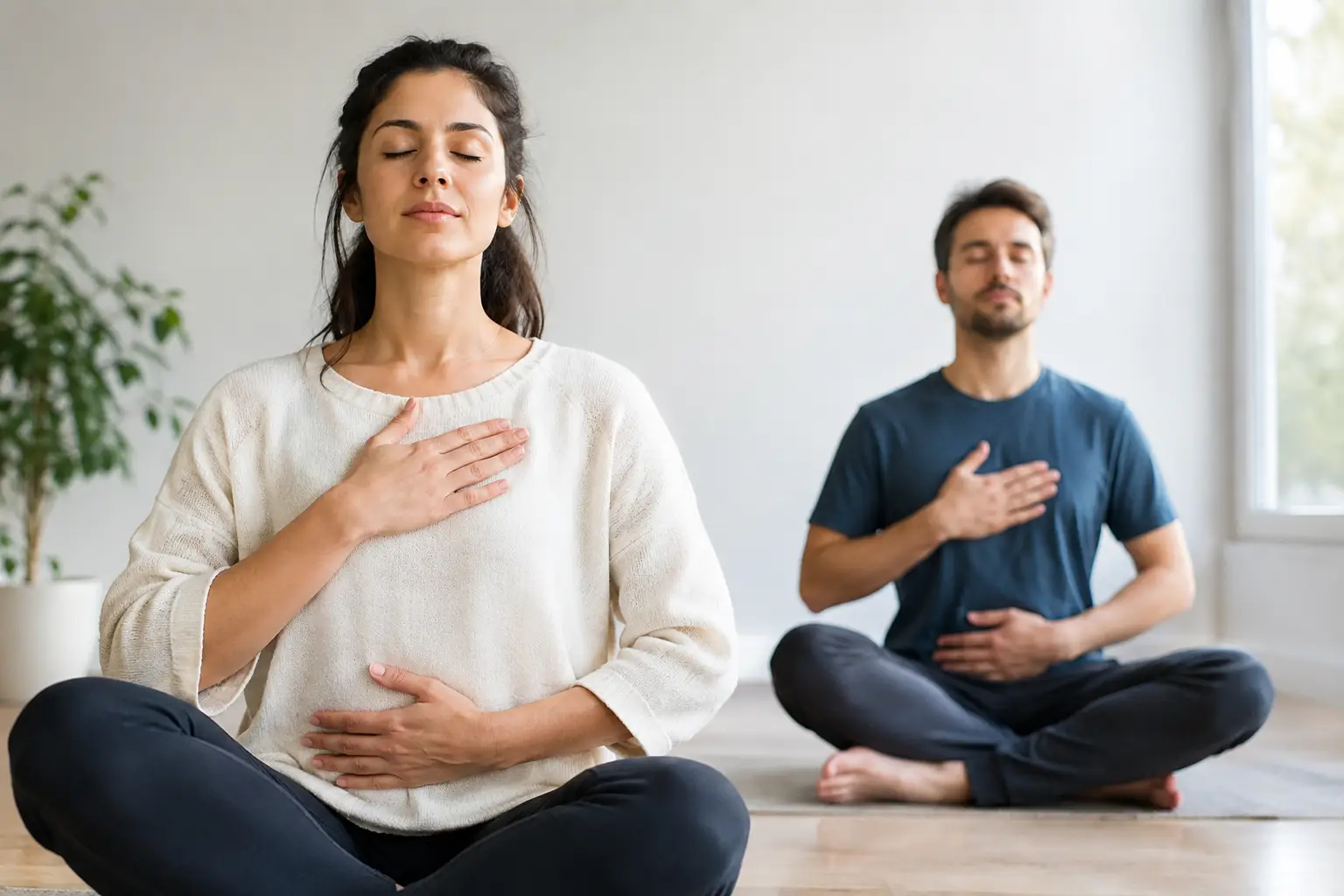
Place one hand over your heart and the other over your lower belly. Feel the warmth and weight of your own hands before changing the breath at all. Then invite a gentle inhale into the lower ribs and belly, followed by a slow, unforced exhale.
As you breathe, offer yourself a simple phrase such as, “I am here”, “This moment is passing”, or “I can meet this one breath at a time.” Choose words that feel believable. A phrase that is too grand can feel distant when you are struggling; a truthful, compassionate sentence has more power.
This practice suits moments of grief, self-criticism or emotional tenderness. The breath becomes less about technique and more about relationship. You are reminding yourself that you do not have to abandon your body when feeling arises.
5. Orienting breath for the senses
Look slowly around the room and let your eyes rest on three neutral or pleasant objects. Perhaps you notice a window, a plant, a familiar mug or the texture of a wall. With each object, take one natural inhale and one longer exhale. Then listen for two sounds. Finally, feel one point of contact beneath or behind you.
This is breathwork woven into orienting, a useful approach when closing your eyes makes you feel less settled. Grounding does not have to be an inward journey. Sometimes the most regulating thing you can do is recognise that you are in a real room, in the present day, with choices available to you.
For group facilitators, invite people to keep their eyes open or softly lowered. This small permission can make a profound difference for participants who feel safer when they remain connected to their surroundings.
How to know which practice you need
Your body usually gives you a clue. If you feel wired, restless or caught in fast thoughts, try the extended exhale. If you feel disconnected or spaced out, feet-to-earth breathing and orienting breath may be more supportive. If you feel tender or emotionally raw, hands on heart and belly can offer a gentler landing place.
There is no single best technique. What regulates one person may frustrate another, and what helps in the morning may not help after a demanding day. Encourage curiosity rather than judgement. Try a practice for two minutes, notice what shifts, and adjust from there.
This is also an essential lesson for anyone called to guide breathwork. Competent facilitation is not about applying the same method to every body. It is about listening, observing, offering choice and knowing when less is more. At Nalu Breathwork, heart-centred practice and responsible space holding belong together because transformation is supported by safety, consent and genuine presence.
Let grounding become part of your rhythm
You do not need to wait for a crisis to use these practices. Take three slower breaths before opening your laptop, place your feet on the floor after a challenging call, or orient around the room before you begin a circle. Small repetitions teach the body that returning is possible.
The next time you notice yourself rushing ahead of the moment, resist the urge to fix everything at once. Feel one point of contact, take one kind breath, and let that be enough for now.