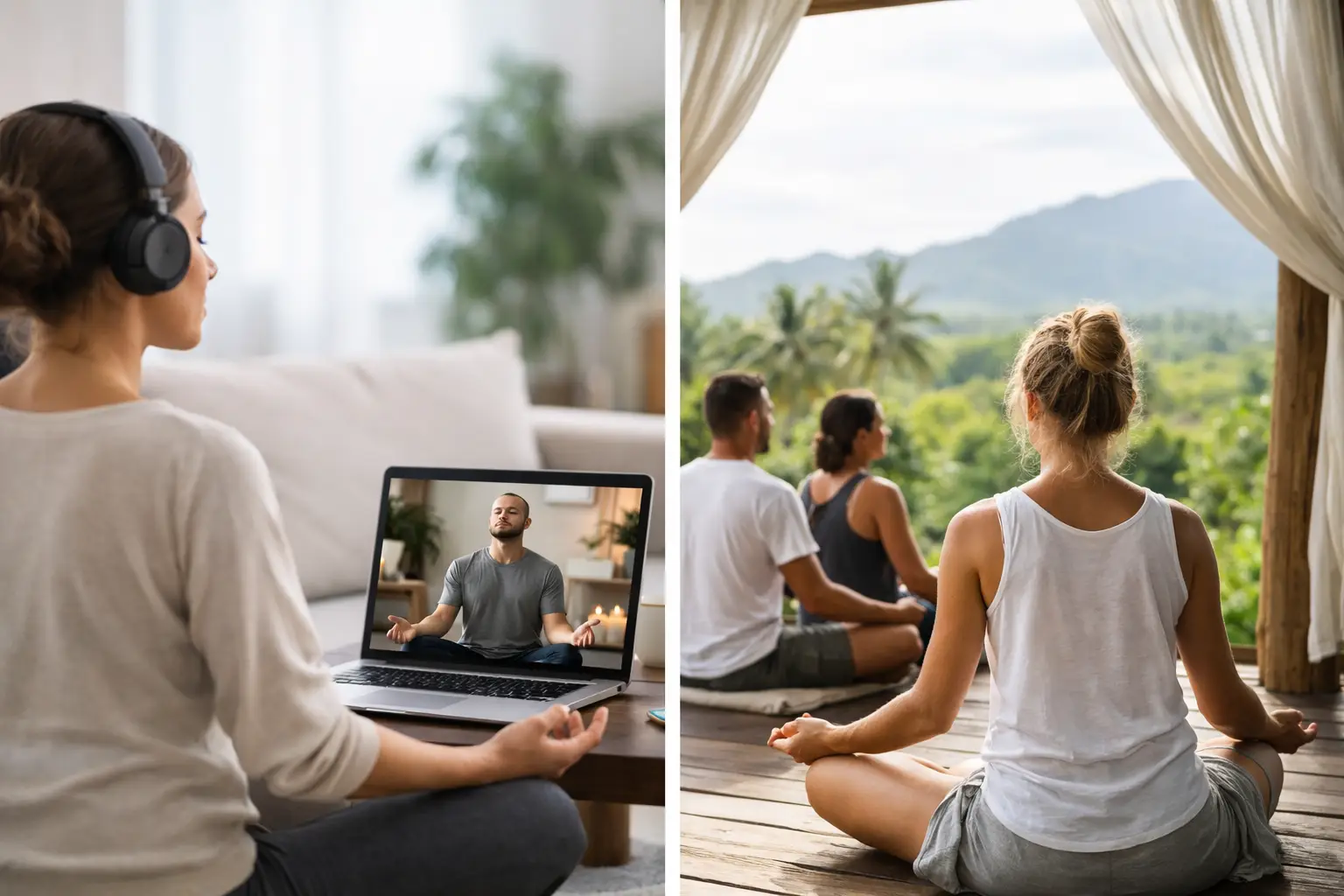
You can feel the difference before anyone explains it. One path asks you to clear your diary, board a plane, and step fully out of ordinary life. The other invites you to learn from home, integrate slowly, and build your skills around real commitments. When you are weighing an online breathwork course versus retreat, the real question is not which one sounds more magical. It is which one will truly support your healing, your confidence, and your ability to hold others well.
For many conscious souls, this choice sits at the meeting point of calling and practicality. You may be a yoga teacher, therapist, coach or bodyworker who knows breathwork belongs in your work. You may also have clients, family responsibilities, or a business that cannot simply pause for a week or two. That does not make your path less committed. It just means the right training format matters.
Online breathwork course versus retreat: what changes most?
Both formats can teach breathwork. That is the simple answer. The deeper answer is that they shape your learning in very different ways.
An online course usually offers flexibility, repetition, and time for integration. You can revisit lessons, practise at your own pace, and absorb material in layers. For someone learning facilitation, that can be a gift. Breathwork is not only about understanding a method. It is about embodying rhythm, safety, presence, and the capacity to stay grounded while another person moves through emotion, release, or insight. Self-paced study gives you space to let those skills settle into your nervous system rather than rushing to keep up.
A retreat offers immersion. You are held in a dedicated environment, often away from your daily roles, distractions and habits. That intensity can create rapid personal shifts. It can also deepen community connection very quickly. If you learn best by being fully present in a room, receiving live feedback, and experiencing the energy of shared practice, a retreat may feel profoundly aligned.
Neither format is automatically better. The better choice depends on how you learn, what season of life you are in, and what you want from the training.
The case for an online breathwork course
Online learning suits people who are serious but stretched. If you are balancing client work, a family, travel limits, or financial considerations, studying from home can make facilitator training possible when a retreat is not.
There is another strength that often gets overlooked. Online courses can create a more realistic bridge into professional practice. You are not learning in a bubble. You are learning while living your actual life. That means you are already practising integration, boundaries, scheduling, and consistency – the same qualities you will need if you want to lead 1:1 sessions, couples sessions, workshops or groups.
For some trainees, online study also feels emotionally safer. Breathwork can bring grief, stress, old stories and deep release to the surface. Being able to process in your own home, in familiar surroundings, can help you stay resourced. You can pause, revisit material, and move at a pace your body genuinely agrees with.
That said, online training asks for self-responsibility. No one is standing at the front of the room calling you into presence. You need discipline. You need honesty about whether you will complete the modules, practise regularly, and seek support when something feels unclear. If you tend to procrastinate or rely on external structure, this format can feel too loose unless the programme itself is very well designed.
The case for a retreat experience
A retreat can be transformational in ways that are hard to replicate online. There is power in stepping out of routine and entering a dedicated container for healing and learning. When the days are shaped around breath, reflection, practice and community, your attention sharpens. You are not squeezing study between errands. You are living it.
For future facilitators, that immersion can accelerate confidence. You witness group dynamics in real time. You feel the importance of pacing, music, touch boundaries, emotional safety and energetic leadership in your own body. You also receive immediate feedback from trainers and peers, which can quickly refine how you hold space.
Retreats often attract those who are craving not only a qualification but a rite of passage. If you know you need a strong line in the sand – a moment where you fully commit to this path – travelling to train can carry real symbolic weight.
Still, intensity is not the same as readiness. A beautiful retreat can open your heart and leave you inspired, but if there is not enough structure around methodology, practice, contraindications, and professional application, inspiration alone will not prepare you to facilitate safely. A retreat should deepen embodiment, not replace solid training.
Certification, safety and professional readiness
This is where the conversation becomes more grounded. If your aim is to become a certified facilitator who can work professionally, the format matters less than the quality of the training.
Ask whether the programme teaches more than personal experience. You need to know how to lead breath journeys safely, recognise when a client may need a different level of support, and hold space for emotional release without drifting into guesswork. You also need practice with different session types. Guiding one person, supporting a couple, and facilitating a group all require different skills.
A strong training should also be clear about what completion leads to. Can you use the qualification professionally? Does it support insurance eligibility where relevant? Does it prepare you to lead paid sessions, workshops, retreats or sacred circles with integrity?
This is one reason some students are drawn to structured schools such as Nalu Breathwork, where the heart of the work remains deeply healing and spiritually grounded, while the training also speaks clearly to facilitator competence. That blend matters. The soul of the work and the professionalism of the work should walk together.
Cost, access and the reality of your life
Money and logistics matter, even on a soul-led path. A retreat usually involves higher costs once you include travel, accommodation, meals, and time away from work. For some, that investment feels worthwhile because the immersive container creates momentum they would not find at home.
For others, the same cost creates unnecessary pressure. If paying for a retreat leaves you anxious, depleted or scrambling, the learning may suffer. An online course can be more spacious financially and emotionally. It may allow you to train without disrupting your income or overextending your nervous system.
Access is not only financial, either. Some people cannot travel easily due to health, caring responsibilities or visa limitations. Online learning can open the door without asking you to prove your commitment through inconvenience.
Which format is better for personal healing?
It depends on what kind of support helps you go deeper.
If you open most fully when you are held in community, away from your usual environment, a retreat may create the conditions for a powerful shift. If your system needs familiarity, privacy and time to process slowly, online learning may be kinder and more effective.
There is also a simple truth many people miss. Healing is not measured by how intense the setting looks from the outside. A quiet practice repeated over weeks can change a life just as much as a dramatic breakthrough on retreat. Sometimes more, because it actually stays with you.
How to choose with clarity
Instead of asking which option sounds more impressive, ask which one you will fully meet.
Will you complete the online training with devotion, practising consistently and taking the material into your body? Or do you know you need the accountability and immersion of a retreat to truly show up? Are you seeking personal transformation, professional certification, or both? Do you want time to integrate gradually, or are you ready to step into an intensive container and be changed by it?
The wisest choice is often the one that matches your real life while stretching you in the right way. Not into overwhelm. Into alignment.
For some people, the answer is online first, retreat later. Build strong foundations, then deepen through immersion. For others, a retreat becomes the ignition point that confirms their path. There is no lesser route here if the training is sound and your intention is true.
Breathwork asks us to listen beneath performance and into truth. Let your decision come from that place. The right training will not only teach you how to guide the breath. It will help you become the kind of facilitator whose presence feels safe, steady and genuinely transformational.